Major cities report rise in light precipitation due to climate conditions. Metropolises are seeing an increase in light precipitation compared to suburban areas. Research shows cities are getting not only warmer, but also more humid. Air pollution and dense development are key contributing factors.
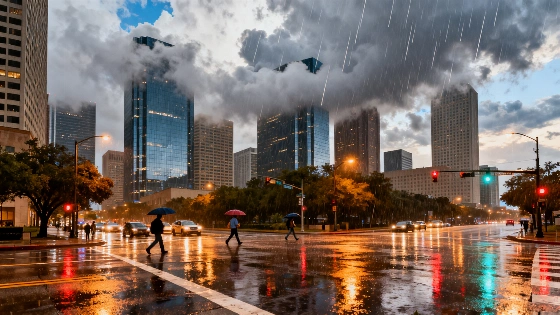
In the world's largest cities, the effect of so-called "urban wet islands" has significantly intensified over the past twenty years. A new study has shown that megacities receive more light precipitation than the surrounding rural areas. This is especially pronounced in Houston, where 12 centimeters more rain falls annually than in the suburbs. A similar trend is observed in other major cities in North America, East Asia, and Western Europe.
The reason for this difference is attributed to the characteristics of the urban environment. High-rise buildings, dense road networks, and high levels of air pollution alter air circulation and the thermal balance. As a result, a unique microclimate forms: the air becomes not only warmer but also more humid, and precipitation more often takes the form of drizzle and light rain.
Satellite data and the geography of the effect
A group of scientists led by Mingze Ding from the Ocean University of China in Qingdao analyzed satellite weather observations. Their goal was to find out how additional precipitation is distributed in cities: whether it falls evenly throughout the year or is concentrated in separate downpours. The results, published in the journal Earth’s Future, showed that in more than two-thirds of the world's major cities, an increase in light precipitation compared to rural areas is being recorded.
However, the effect turned out to be uneven. In major cities of North America, East Asia, and Western Europe, drizzle and light rain have become noticeably more frequent. Meanwhile, in tropical cities of South and Southeast Asia, the opposite is observed: here, urbanization increases extreme downpours rather than drizzle.
Practical implications for cities
Regular light precipitation, despite the inconvenience for residents, helps maintain surface water levels in cities. This is especially important for megacities with high population density and intensive resource use. At the same time, the unevenness of the effect requires taking regional characteristics into account when planning urban infrastructure and water supply.
The study emphasizes that urbanization changes not only temperature but also the structure of precipitation. For city authorities, this is a signal to review their approaches to water resource management and adapt to new climate conditions.