Spain Named Favorite for 2026 World Cup by Statistical Model Forecast. A statistical model has assessed the national teams' chances of winning the 2026 World Cup. Spain leads with a probability of 16–17%, but even favorites rarely reach the final. Football remains unpredictable due to the role of chance.
Spain has been given the status of main favorite for the 2026 FIFA World Cup following large-scale statistical modeling. According to the calculations, the probability of the Spanish national team winning is 16–17%. However, even with such an advantage, the team wins the tournament only in one out of six simulations, highlighting the high level of uncertainty in football.
The second and third highest chances belong to France and Argentina — 12% each. At the same time, the combined probability of the three leaders does not even reach half of all possible outcomes. This result is explained by the specifics of the tournament: teams play few matches, and the five knockout rounds are by elimination, where a single goal can decide the outcome.
The model is built in two key stages. First, the strength of each team is assessed by a number of indicators: Elo rating, squad value, as well as additional factors such as home advantage, age and league of players, and historical rating. Then, a series of tournament simulations is carried out — up to 100,000 times — to obtain stable probabilities for each outcome.
To calculate the probability of winning a particular match, not only the current form and value of the players are taken into account, but also such details as the venue and historical performance. For example, if Spain faces Germany on neutral ground, the probability of a Spanish victory is estimated at 52%, while defeat is at 21%.
Simulations reveal not only the favorites, but also likely scenarios for how the tournament will unfold: potential opponents at different stages, chances of securing a certain position in the group, and the likelihood of tough matchups already in the early rounds. For example, at the start of the tournament, Spain had a 31% chance of facing Argentina already in the first round of the playoffs.
Despite the complexity of the calculations, the authors admit that it is impossible to completely eliminate the element of chance. Even the most accurate models cannot predict every nuance: from players' conditions to random moments on the field. History has seen cases where mathematical approaches have brought success — as with Tony Bloom and Matthew Benham, who used such models to profit from betting and acquire football clubs.
In recent years, such forecasts have become increasingly popular, with both academic centers and private companies publishing their own models. However, as experts note, bookmakers and prediction markets remain extremely difficult to beat. Even if a model proves more accurate for a particular tournament, achieving a stable advantage is nearly impossible.
The methodology for building the model includes three main components: calculating team strength (using Elo ratings, squad value, and historical data), simulating individual matches taking numerous factors into account, and large-scale modeling of the entire tournament. The training dataset consisted of almost 19 thousand national team matches since 2004, including World and European Championships. The model is based on a Poisson distribution and takes into account the probability of draws using the classic Dixon & Coles approach.
Validation showed that the model's accuracy in determining match outcomes (win, draw, loss) averages 59%, and around 55% in the final stages of major tournaments. However, it is more important not to guess the winner, but to properly assess event probabilities. For this, the Ranked Probability Score metric is used, by which the new version of the model for the 2026 World Cup outperforms previous versions.
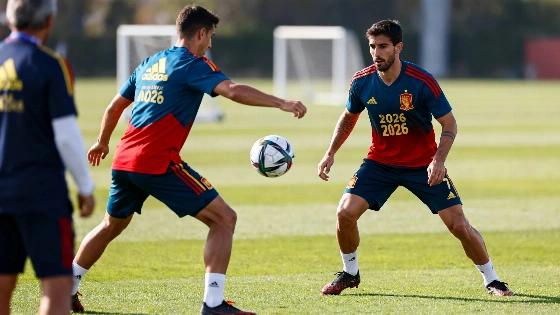
In the context of Spain's national team's preparations for the tournament, it's worth noting that the team enters the championship with a refreshed lineup and a record unbeaten streak, while fan zones are already being set up in Madrid for supporters — you can read more about this in the article about Spain's national team kicking off at the 2026 World Cup.
For reference: the Elo rating is a system that evaluates a team's strength based on match results, where a victory over a stronger opponent earns more points. Squad value is determined according to Transfermarkt, taking into account the players’ age and league. The model also factors in home advantage and the national team’s historical consistency. Despite analysts’ best efforts, football remains one of the most unpredictable sports, where even the most accurate forecasts do not guarantee success.