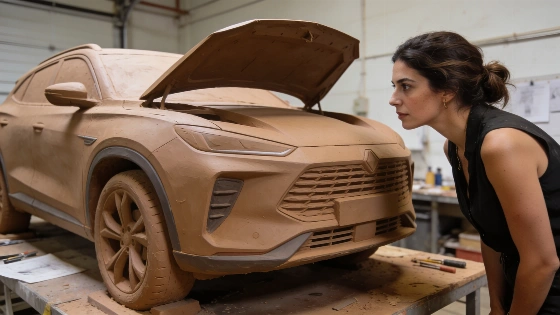
Safety requirements have made very low, sharply pointed cars almost impossible to design, Marta Beltrán says. The mobility-concept designer told the Al Corte podcast that regulations shape the forms designers can use, leaving less room for familiar styling choices.
Beltrán links taller vehicle fronts to the need to reduce risks in side impacts and limit harm to pedestrians in a collision. Designers cannot position the bonnet freely to alter a pedestrian’s trajectory, she explained. That constraint also pushes them towards a higher front end. Pedestrian-impact assessments examine what happens when contact occurs: tests use headforms against the hood and windshield area, an upper-leg impactor at the hood’s leading edge and a lower-limb impactor at the bumper. NHTSA’s model-year 2027 assessment covered 102 vehicle models from 10 manufacturers, using those three impact areas.
The result is especially noticeable to drivers who find modern models, including SUVs, visually similar. Beltrán says the rules are unlikely to change soon. Manufacturers have to follow them whether or not buyers like the resulting look. In the United States, Federal Motor Vehicle Safety Standard No. 127 requires light vehicles manufactured on or after September 1, 2029, to meet pedestrian forward-collision-warning and automatic-emergency-braking requirements. Its operating conditions include vehicle speeds above 10 km/h and below 73 km/h. The rule addresses collision avoidance through warning and braking systems, while pedestrian-impact assessments measure injury risks when a collision occurs.
Front-end engineering also shows competing safety and packaging targets. For example, the second-generation Volkswagen T-Roc is listed at 1,573 mm tall. The cited Euro NCAP figures for the model are 91% adult-occupant protection, 87% child-occupant protection, 87% pedestrian protection and 77% safety assist. In the United States, NHTSA’s New Car Assessment Program offers standardized consumer comparisons, distinct from mandatory vehicle standards. Federal rules require safety-rating information on the vehicle’s Monroney label under 49 CFR Part 575.
RUSSPAIN has also covered the Cupra Raval VZ in a model-focused report. Beltrán’s comments address the broader constraints shaping car design.
She describes a clear shift across decades. In the 1950s, chrome and tailfins drew inspiration from aircraft. Wedge-shaped designs gained favour in the 1960s and 1970s for their futuristic appearance. Beltrán says today’s similarities reflect common regulations and brands’ fear of looking different.