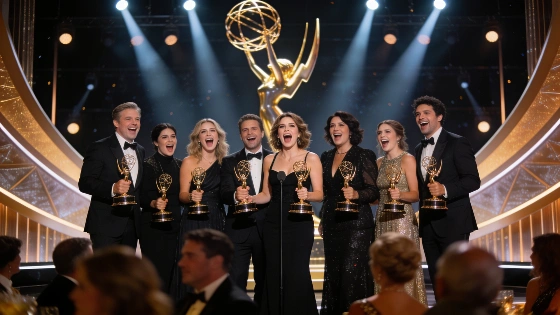
La maldición de Widow’s Bay swept the 2026 Emmy Awards, taking home fourteen of nineteen possible trophies and upending expectations for a first-year show. The series blended horror with comedy, left established favorites like Hacks behind and pushed the Academy to break with its usual routines. BBC and NPR reported that the show led the nominations and finished as the night’s most-awarded series at the 78th Primetime Emmy Awards in Los Angeles.
This year, the ceremony opened with comedy instead of the traditional drama category. Mariska Hargitay hosted for the first time, and the change in order put the comedy race in the spotlight. By the end, La maldición de Widow’s Bay had claimed Best Comedy Series. Creator Katie Dippoll accepted the award and thanked her mother for making Halloween "always so much fun," a fitting nod for a show built on the macabre. BBC’s live coverage noted that the ceremony’s structure had not changed in years to reflect a comedy’s dominance.
Matthew Rhys became the first performer to win two lead acting Emmys in different categories on the same night, for both 'Widow’s Bay' and 'The Beast in Me'.
BBC
Matthew Rhys was the night’s surprise double winner, first for his role in a miniseries and then as Best Lead Actor in Comedy for Widow’s Bay. He looked genuinely surprised as he thanked his wife Keri Russell and his family, then invoked his Welsh roots: "We have a small but mighty nation." In the supporting categories, Stephen Root won Best Supporting Actor in Comedy and credited Dippoll’s writing, while Kate O’Flynn took Best Supporting Actress for her role as Patricia, the mayor’s eccentric assistant. O’Flynn dedicated her win "to all the Patricias out there." BBC called her victory one of the night’s biggest surprises; she beat several well-known nominees.
Behind the scenes, Dippoll’s patience finally paid off. She wrote the pilot for La maldición de Widow’s Bay eighteen years ago, and this year she won both Best Directing and Best Writing in Comedy, beating the finale of Hacks in both categories. The show’s sweep was more than a win for its cast and crew: it showed that persistence and originality can break through in an industry that often favors the familiar. NPR and BBC noted that Dippoll’s wins for writing and directing highlighted the show’s creative strength beyond its performances.
Drama categories brought fewer surprises. The Pitt’s second season won Best Drama Series, as many expected. Creator R. Scott Gemill used his speech to thank the real-life medical community that inspires the show and stressed the importance of telling honest stories: "People need to know the truth and we have to keep telling it, but we can."
While some outlets reported six televised wins for 'Widow’s Bay', BBC’s live coverage clarified that the series earned a total of fourteen awards across all categories, making it the most decorated show of the evening.
BBC News
Jean Smart won Best Lead Actress in Drama for her role as Deborah Vance in Hacks, marking her fifth Emmy for the part and making her the only actor to win for every season of a series. She thanked her children and the show’s creative team, led by Lucia Aniello. Jen Statsky and Paul W. Downs were also part of the team behind her success. Allison Janney’s win for Best Supporting Actress in La diplomática surprised even her, since four of the seven nominees were from The Pitt. Tom Pelphrey rounded out the drama categories with Best Supporting Actor for Task, thanking his family and his wife, Kaley Cuoco.
The ceremony itself broke from routine. Mariska Hargitay’s first turn as host brought energy to the event and a musical tribute to TV history. Taylor Swift and her cat Olivia made a surprise appearance. Michael J. Fox received the Bob Hope Humanitarian Award, while tributes to Dolly Parton and Catherine O’Hara added emotional moments to a night full of upsets and milestones.
La maldición de Widow’s Bay’s sweep signals a shift at the Emmys, where risk-taking and genre-mixing are gaining recognition over safe, familiar choices. The Academy’s decision to let a newcomer dominate and change the ceremony’s structure in response points to an industry ready for new voices and bold storytelling. For viewers and creators, the message is clear: the era of playing it safe is over, and those willing to take creative risks may finally get their chance, even if it takes years.