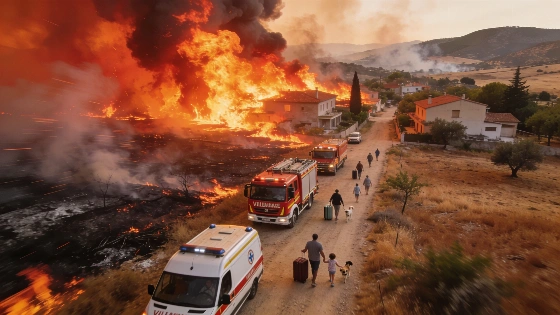
Emergency measures were enacted in Villa del Prado on Sunday after a fast-moving wildfire broke out in Almorox, Toledo. Authorities evacuated the El Encinar del Alberche residential area and instructed the rest of the town’s residents to remain indoors. The fire, which began in the afternoon, advanced toward the Madrid region, prompting a rapid response from local and regional services.
Madrid’s emergency coordination center, ASEM112, said residents of El Encinar del Alberche were relocated to the municipal sports center in Villa del Prado as a precaution. A confinement order was issued for the rest of the town, with officials urging people to keep doors and windows closed until further notice. An ES-Alert message was sent to deliver instructions to affected households.
Firefighting efforts intensified as the situation developed. The Community of Madrid activated level 2 of its Infoma wildfire protocol, deploying 15 ground and aerial units from the Fire Brigade and Forest Firefighters. Forest Agents also joined the operation. Additional support came from Infocam, the Castilla-La Mancha regional wildfire service, bringing the reported total to 19 units. The coordinated response aimed to contain the flames and protect residential areas and critical infrastructure.
Transport disruptions followed. The N-403 was closed between the Cadalso de los Vidrios junction and Almorox, while the M-507 was shut in the direction of Navalcarnero. The closures supported emergency operations and restricted civilian access to hazardous areas. Residents were urged to stay indoors and avoid travel in the affected locations.
The Almorox incident formed part of a wider wildfire emergency affecting several areas in and around Madrid and Toledo. A later report said approximately 11,500 people were evacuated across the affected areas; more than 10,000 of those evacuations were reported in the Community of Madrid in connection with three fires, including those affecting Villa del Prado and San Martín de Valdeiglesias. The Almorox fire was described as stabilizing at that point, while the Madrid-area fires accounted for the largest evacuation impact. These regional totals cover multiple fires and municipalities, not El Encinar del Alberche alone.
The Community of Madrid subsequently approved €3 million in aid for businesses and self-employed workers in municipalities affected by the Sierra Oeste wildfire, with the stated aim of supporting economic recovery. The regional government set 23 July 2026, the date the emergency was declared to be of national interest, as the eligibility threshold: businesses and self-employed activities had to have begun before that date. The regional Council of Government authorized the measure, which is administered by the Department of Economy, Finance and Employment. The structure was later extended to include Camping El Escorial, following certification of its evacuation by Madrid’s Security and Emergency Agency 112.
Wildfires are a recurring challenge in Spain, particularly during periods of high temperatures and dry conditions. The response in Villa del Prado involved coordination between regional services and Castilla-La Mancha’s wildfire service. Severe weather events and fire risks have also caused disruptions in other regions, including Valencia and Murcia, as covered in recent coverage of weather alerts and fire dangers in southeast Spain.
Spain’s wildfire response relies on rapid public alerts and evacuation procedures, backed by coordination among local and regional emergency services. The Almorox fire prompted evacuations, confinement instructions and road closures, while the subsequent regional aid decision marked a shift toward supporting economic recovery in affected communities.