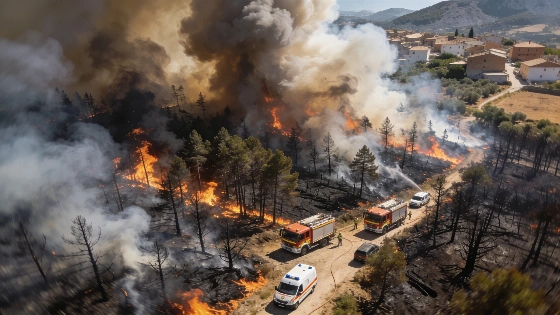
A fast-moving wildfire near Tamarite in Huesca has forced the evacuation of three villages, with flames already consuming around 2,500 hectares. Emergency services remain on high alert. Authorities warn that the affected area could grow further if conditions do not improve.
The fire broke out near Tamarite de Litera and spread quickly, prompting firefighters and local officials to respond, information from the regional government. Officials currently estimate the blaze’s perimeter at 4,400 hectares. Crews are working to contain it and protect residential areas and critical infrastructure.
After a meeting of the CECOP emergency committee, Roberto Bermúdez de Castro, Aragón’s regional minister for Finance, Interior and Public Administration, said the total area affected could reach 4,000 hectares once the fire is fully contained. Officials believe forest land accounts for between 15% and 20% of that area, adding to the threat to local communities.
Authorities have evacuated two urban centers and a third nearby village, prioritizing residents’ safety. Firefighters from Aragón, backed by local and regional resources, are establishing control lines to limit the flames’ spread. The response has so far kept the fire within the established perimeter, but officials remain cautious because wildfires in the region can behave unpredictably.
The Tamarite fire is part of a wider challenge for Aragón. Officials later described the 2026 season as exceptionally difficult, with five major forest fires and 35,675 hectares burned across the region. Regional environmental official Biendicho called the campaign “extraordinarily complex” and said, “The best forest policy is one that trusts its professionals.” The official pointed to active forest management and trained crews as basic to prevention and response.
A separate major Huesca wildfire began on 10 August 2026 near Santa María de la Peña, alongside work on the A-132 road, then spread through extensive pine forest. It forced the evacuation of 1,046 people from 19 population centers, as well as two campsites and one camp. Emergency estimates put its affected perimeter at about 18,400 hectares, while satellite estimates indicated around 14,500 hectares burned. A later technical assessment mapped 16,285.23 hectares across municipal boundaries. That figure reflects a different measurement method, not a revised estimate of the area physically burned.
In the separate fire’s municipal breakdown, Las Peñas de Riglos accounted for 7,012.26 hectares and Bailo for 4,996.67 hectares. Together, the two municipalities represented 12,008.93 hectares, or 73.74% of the mapped total. The assessment also classified 7,556.18 hectares as public-utility forest land, a designation relevant to restoration and future land management. After the emergency, Aragón officials met with affected local councils in Jaca. Provincial environmental technicians said they had completed classification of the entire burned area to support damage assessments and set intervention priorities.
Authorities have also pursued separate financial support for communities affected by the summer fires. Spain’s national response included €9 million in aid for agricultural holdings, against a national assessment of about 270,000 hectares affected by fires, including roughly 60,000 hectares of agricultural land. In Aragón, a separate regional fund of €3 million for self-employed workers and small and medium-sized businesses had received 44 applications seeking a combined €433,189.
Wildfires recur across Spain, particularly in summer, when high temperatures and dry conditions raise the risk. Aragón’s extensive rural and forested areas make prevention and emergency response especially consequential, as does long-term restoration. The region has focused on active forest management and professional wildfire personnel, alongside recovery measures for affected farms and businesses.
Local authorities are urging residents to follow official instructions and watch for further updates. Officials will assess the full damage once the Tamarite fire is under control. For now, the focus remains on safeguarding lives and preventing further destruction.