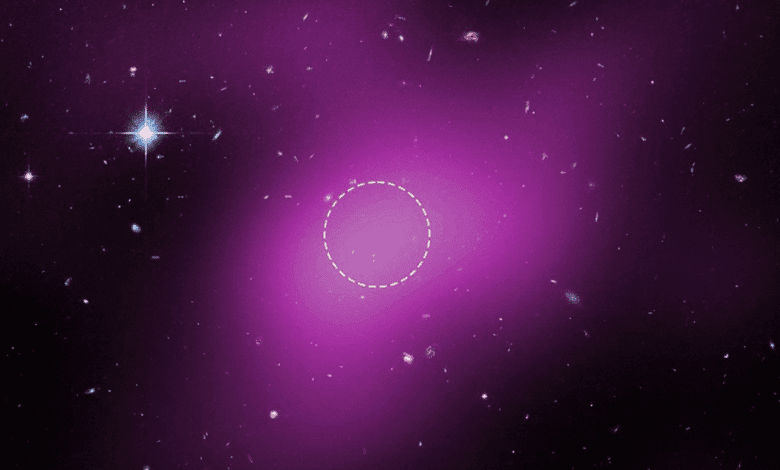
A real sensation has swept the scientific community: a team of astronomers using the Hubble Space Telescope has discovered something previously known only from theoretical predictions. About 14 million light-years from Earth, on the outskirts of the spiral galaxy M94, they found a cloud with not a single star. This object—unofficially named Cloud 9—is a dense accumulation of dark matter and hydrogen, and is arguably one of the most intriguing discoveries in recent years.
Cloud 9 is more than just another astronomical curiosity. Its existence supports the hypothesis that such clouds in the early universe served as building blocks for future galaxies. However, in this case, the process took an unexpected turn: the gas gathered, but stars never formed. Why? Finding the answer could shed light on the mysteries of dark matter, which, according to calculations, makes up as much as 85% of the universe’s total mass but remains invisible to our instruments.
Scientists are openly excited: for the first time, they’ve managed to ‘capture’ an object so dominated by dark matter that ordinary matter—hydrogen—could not trigger star formation. This is not just rare; it’s a true cosmic rarity that could hold the key to understanding how the first galaxies formed and why some of them became ‘failures.’
Dark matter: the invisible conductor
Dark matter is a mysterious component of the Universe that does not emit light and does not interact with electromagnetic radiation. Scientists infer its existence by observing its gravitational influence on ordinary matter. According to current scientific understanding, it is dark matter that shapes the structure and evolution of the cosmos.
Cloud 9 is a so-called RELHIC (Reionization-Limited Hydrogen I Cloud), where hydrogen began to accumulate but never reached the critical density needed for star formation. Unlike the familiar gas clouds that surround the Milky Way, this object is compact, almost perfectly spherical, and remarkably stable. Its core consists of neutral hydrogen, and its diameter is nearly 5,000 light-years. The hydrogen mass is about one million solar masses, but there is five thousand times more dark matter present.
The possibility of such ‘fossils’—relic clouds that never evolved into galaxies—has long been discussed in scientific circles. But only now, thanks to the high sensitivity of Hubble’s cameras, has it been proven: not a single star exists inside Cloud 9, not even the faintest. This is not a dwarf galaxy, but rather a ‘failed’ prototype.
Failed galaxy
Lead researcher Alejandro Benitez-Llambay from the University of Milano-Bicocca does not hide his satisfaction: “In science, we often learn more from failures than from successes. In this case, the absence of stars is the best possible proof of the theory.” Cloud 9 is a kind of ‘abandoned house’ among its galactic neighbors, one that never became a full-fledged galaxy.
Colleagues from the Space Telescope Science Institute (STScI) note that, if not for Hubble’s capabilities, this object could easily be mistaken for a faint dwarf galaxy invisible from Earth. But now there is no doubt: we are looking at a unique example of how dark matter can ‘strangle’ star formation, leaving behind only a cloud of gas.
Interestingly, Cloud 9 differs from known hydrogen clouds around the Milky Way not only in size and shape, but also in internal structure. Its dark matter mass is estimated at five billion solar masses, making it a true heavyweight among such objects.
A window into the Universe’s past
The discovery of Cloud 9 opens up new horizons for astronomers. If such objects are indeed common, it could mean that the Universe hides many ‘abandoned’ protogalaxies that never became homes for stars. Perhaps they played a key role in the formation of massive galaxies, acting as the ‘building blocks’ of cosmic architecture.
Scientists are now closely monitoring new sky surveys, hoping to find even more such relics. Each of these objects offers a chance to glimpse an era when the Universe was just beginning to take on familiar shapes. And perhaps it is within these clouds that the secret of dark matter lies, a mystery that still eludes direct observation.
Cloud 9 is more than just a scientific sensation—it’s a real challenge for anyone trying to understand how our universe works. Its existence proves that space is full of surprises and the most important discoveries are still ahead.
RUSSPAIN reminds that the Hubble Space Telescope was launched into orbit in 1990 and has revolutionized astronomy ever since. Thanks to its observations, thousands of new objects have been discovered, the parameters of the Universe’s expansion refined, and unique images of distant galaxies captured. Hubble continues to operate today despite its age, and remains one of the most valuable tools for exploring the depths of space.