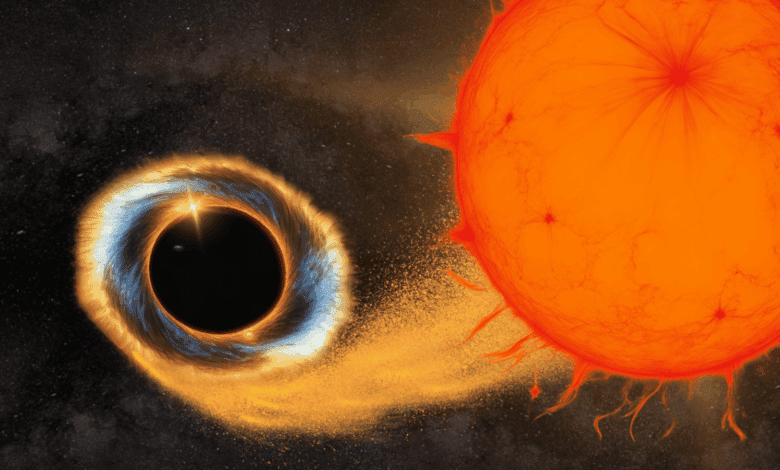
In the constellation Centaurus, about 3,800 light-years from Earth, astronomers have found a star that defies the usual laws of stellar evolution. The red giant in the Gaia BH2 binary system, orbiting a black hole, turned out to be significantly younger than experts expected. This discovery was made thanks to observations from NASA’s TESS (Transiting Exoplanet Survey Satellite), which detected unusual star vibrations—so-called starquakes.
Starquakes, much like earthquakes, enable scientists to peer inside stars and learn about their internal structure. By analyzing these oscillations, researchers found that the red giant Gaia BH2 has a chemical composition typical of very ancient stars, yet it is only about 5 billion years old. For comparison, our Sun, which is now 4.6 billion years old, will not reach the red giant stage for several more billion years.
The age mystery
Usually, stars rich in heavy elements—the so-called alpha-enhanced stars—are considered relic objects formed at the dawn of our Galaxy. However, Gaia BH2 turned out to be an exception. Its young age and ‘ancient’ chemistry don’t fit standard models of stellar evolution. This has led scientists to suspect that the star underwent unusual events in its past.
One possible explanation is a merger with another star or the accretion of material from a companion. Such a process could not only alter the red giant’s chemical composition, but also speed up its rotation. Indeed, observations show that the star completes a full rotation in 398 Earth days, which is significantly faster than other single red giants of a similar age.
The influence of the black hole
Another interesting aspect is the interaction with the black hole, which is the second object in the Gaia BH2 system. Astronomers believe that proximity to such a massive neighbor could have accelerated the star’s rotation. Mutual tidal forces and the transfer of material between these objects are capable of radically changing the evolution of both components of the system.
Researchers note that this rapid rotation cannot be explained by the star’s original characteristics alone. This further confirms that the Gaia BH2 red giant experienced a powerful external influence in the past, possibly even a collision or merger with another star. Such events are extremely rare and of great interest to science.
Comparison with other systems
At the same time, scientists studied another binary system with a black hole—Gaia BH3, located only 2,000 light-years from Earth. Here, the black hole’s companion turned out to be poor in heavy elements, which is also unusual. Moreover, unlike Gaia BH2, no characteristic vibrations were detected in the star of Gaia BH3, further complicating the picture.
A comparative analysis of both systems provides deeper insight into how binary systems with black holes form and evolve, especially those that do not actively accrete material from their stellar companions. Such objects long remained outside astronomers’ field of view, but are now becoming an important subject of study.
Future research
Scientists plan to continue monitoring the Gaia BH2 system using the Gaia telescope and other instruments. Special attention will be paid to searching for new starquakes that could confirm the hypothesis of a stellar merger in the past. Such data will help refine models of stellar evolution and shed light on how frequently such events occur in the universe.
The discovery of an unusually young and rapidly spinning star paired with a black hole has already generated considerable interest within the scientific community. The study’s results were published in November 2024 in a leading astronomical journal.
In case you didn’t know, Gaia is a space telescope operated by the European Space Agency (ESA), launched in 2013 to create the most accurate three-dimensional map of our Galaxy. Thanks to Gaia, astronomers have discovered many new stellar systems, including objects with black holes that were previously undetectable. The TESS telescope, in turn, specializes in finding exoplanets and studying variable stars, offering unique data on vibrations and the internal structure of stars.