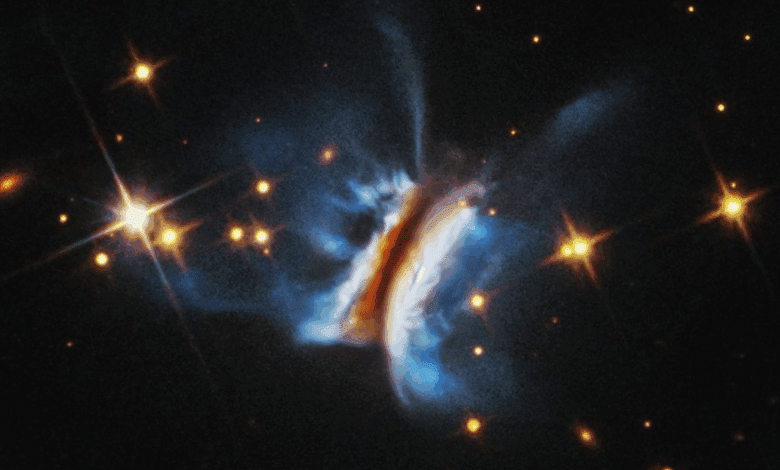
Astronomers have released a striking image taken by the Hubble Space Telescope capturing the largest known protoplanetary disk. This object, nicknamed “Dracula’s Chivito,” is located about a thousand light-years from Earth. Its size is astonishing: the disk’s diameter reaches 400 billion kilometers—about forty times wider than our Solar System up to the Kuiper Belt.
At the very center of this enormous cloud of gas and dust, a young star is forming. What makes this object unique is not only its scale, but also its chaotic structure. The image clearly shows asymmetrical layers and thin, mist-like upper regions. Such detail is extremely rare, even for modern telescopes.
Kristina Monsch, head of the research group from the Harvard-Smithsonian Center for Astrophysics, notes that observing such an active and disorderly ‘planet factory’ is a significant stroke of luck for science. According to her, Hubble enabled researchers to see the disk’s substructures in the visible spectrum with unprecedented clarity, opening up new opportunities for studying planet formation processes.
Chaos and symmetry
Scientists have paid special attention to the asymmetry in the distribution of gas and dust. According to astronomer Joshua Bennett Lovell, these features point to complex dynamic processes occurring within the disk. Interaction with the surrounding environment gradually changes its shape, and observing this process in real time provides unique material for analysis.
Researchers emphasize that such objects had previously only been partially observed, whereas this detailed image literally allows us to ‘peek’ into a laboratory for the creation of new worlds. Monsh is confident that despite differences in scale, the main mechanisms of planet formation in such disks are similar to those that operated in the early Solar System.
A glimpse into the past
The discovery of the ‘Draculina Chivito’ offers a new perspective on the processes that took place billions of years ago during the formation of our planetary system. According to scientists, in theory such a massive disk is capable of producing an entire family of planets, possibly even more numerous than in the Solar System.
However, as Monsh notes, researchers still have more questions than answers. How exactly do planets form in such vast and unstable conditions? Which factors determine their number and characteristics? The new images only fuel interest in these mysteries, presenting science with new challenges.
An unusual name
The nickname ‘Draculin Chivito’ didn’t appear by chance. ‘Dracula’ refers to the Transylvanian roots of one of the project members, while ‘Chivito’ is a popular Uruguayan beef sandwich — the favorite dish of another team member. This play on words gave the object its own personality and made it even more memorable for the general public.
The scientists jokingly note: ‘Don’t worry, Drac, it’s a steak, not a stake.’ Details like this highlight that even in serious science, there is room for personal stories and cultural references.
In case you didn’t know, the Hubble Space Telescope was launched into orbit in 1990 and has since revolutionized astronomy. Thanks to Hubble, humanity has obtained thousands of unique images of distant galaxies, nebulae, and star clusters. Hubble is owned by NASA and the European Space Agency, and its scientific discoveries regularly make headlines in the world of science.