California Skies Put to the Test: X-59 Program Takes Off
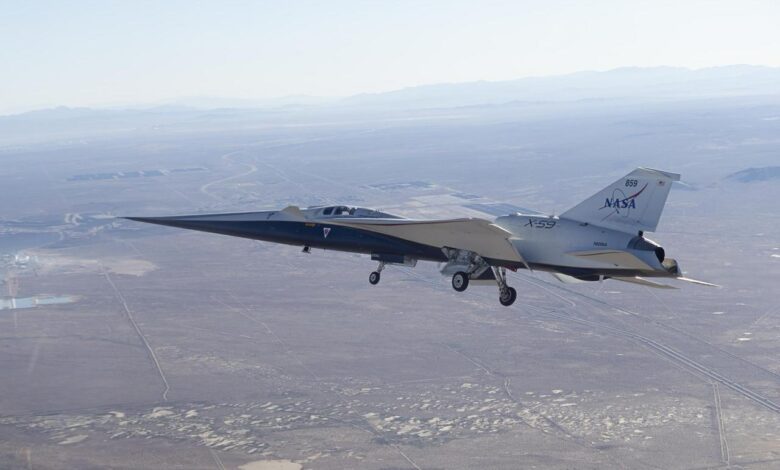
At the end of October 2025, the experimental X-59 aircraft, developed by NASA and Lockheed Martin, made its maiden flight at Palmdale airfield (California). Test pilot Nils Larson took the unique plane into the air, accompanied by an F/A-18 fighter jet. At an altitude of 3.6 kilometers and a speed of 370 kilometers per hour, specialists conducted a series of tests to assess all key systems under real-world conditions. During this phase, the landing gear remained deployed, allowing the team to focus on verifying the craft’s safety and flight readiness.
The flight concluded at Edwards Air Force Base, home to NASA’s Armstrong Flight Research Center. This is where the X-59 will be based for further testing. The maiden flight marks a significant milestone in the ambitious program to create a new generation of civil supersonic aircraft.
Next Phase: Preparing for Full-Scale Flight Testing
Following its successful debut, the team of engineers and pilots began readying the X-59 for the next phase—comprehensive flight testing. In the coming months, experts plan to thoroughly evaluate the aircraft’s handling and stability across various flight conditions. Special attention will be given to reaching the target cruising speed of over 1,700 kilometers per hour and flights at altitudes up to 16,700 meters.
These tests will assess how effectively the new design reduces the intensity of the shock wave. The X-59’s long, slender fuselage is engineered to minimize the merging of shock waves produced when breaking the sound barrier, thereby reducing the sonic boom heard on the ground.
Sonic Boom Reduction Technologies
The main goal of the project is to create an aircraft that can fly faster than sound without the loud boom typical of supersonic jets—a sound that has long prevented such planes from flying over populated areas. According to NASA engineers, the X-59’s sonic boom is expected to be no louder than 75 decibels, roughly equivalent to the slam of a car door. By comparison, the legendary Concorde reached 105 decibels, making its flights over many countries impossible.
During the next phase of testing, NASA plans to conduct a series of so-called ‘community flights.’ During these flights, experts will measure ground-level noise and gather feedback from residents. If the results confirm the predictions, it could lead to a reconsideration of current bans on supersonic flights over land, paving the way for new civilian aircraft capable of dramatically reducing travel time between continents.
Potential Impact on the Future of Aviation
The success of the X-59 program could become a turning point for the entire industry. If the aircraft truly demonstrates low noise levels, this may prompt a review of international standards and regulations that have been in place since the 1970s. In the future, such technologies could be introduced to commercial airliners, enabling supersonic flights between major cities without compromising the environment or residents’ comfort.
For now, the NASA and Lockheed Martin team continues to refine the prototype, analyzing data from the first flight and preparing for further tests. In the coming months, a series of new flights is planned to further verify the X-59’s systems for reliability and safety.
Reminder: what we know about NASA and its role in global aviation
In case you didn’t know, NASA (National Aeronautics and Space Administration) is the United States’ national agency for aeronautics and space exploration, founded in 1958. The agency is known not only for its space missions, but also for its significant contributions to aviation technology. Over the decades, NASA has completed hundreds of projects involving the development of new aircraft, control systems, and materials that have subsequently been used in both civilian and military aviation worldwide.
Among NASA’s achievements are its involvement in developing the first jet and supersonic aircraft, creating unique flying laboratories, and introducing innovative solutions to improve flight safety. The agency works closely with leading global companies such as Lockheed Martin, Boeing, and others, enabling the combination of scientific expertise and manufacturing capabilities to carry out the most ambitious projects.
Today, NASA remains a leader in aviation research, developing technologies that are shaping the future of global aviation. The X-59 program is just one example of how the agency is working to make flights faster, quieter, and safer for everyone. Thanks to such initiatives, the boundaries of what’s possible in aviation keep expanding, and new discoveries are becoming part of everyday life.