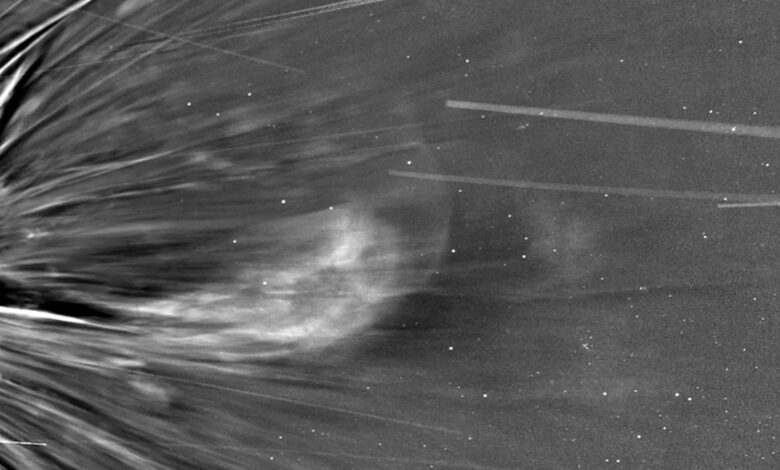
In December 2024, NASA’s Parker Solar Probe made a record-breaking close approach to the Sun’s surface. During this maneuver, the spacecraft observed a unique phenomenon: part of the ejected solar material, after detaching from the star, unexpectedly changed direction and returned. These images are the clearest ever obtained and have given scientists a new perspective on the processes taking place in the Sun’s atmosphere.
A video compiled from a series of images shows how a cloud of superheated plasma bursts into space, initially moving away from the Sun, and then part of it appears to turn around and rush back. This phenomenon is linked to the magnetic fields surrounding the Sun, which are constantly shifting. These fields not only propel material into interplanetary space but can also pull it back, creating a unique cycle.
Magnetic loops
During the flyby, Parker Solar Probe was just 6.1 million kilometers from the Sun’s surface. At that moment, a powerful event took place—a coronal mass ejection (CME), when an enormous clump of plasma erupts outward. Typically, such ejections propel material far from the star, but this time, part of the cloud was pulled back in, following magnetic field lines that suddenly broke and immediately reconnected, forming gigantic loops.
Previously, such processes could only be observed from a great distance, for example, using the SOHO observatory. However, Parker has, for the first time, allowed scientists to study the details of this phenomenon up close. Researchers were able to measure the speed and size of the returning clumps, marking an important step in understanding how the Sun’s magnetic fields form and evolve.
Impact on space weather
Coronal mass ejections play a key role in shaping space weather. If such a cloud is directed toward Earth, it can trigger intense geomagnetic storms, disrupt satellites, interfere with radio communications, and even affect power grids. New data from the Parker Solar Probe will help to more accurately forecast these events and assess their possible consequences for our planet and other bodies in the Solar System.
Researchers paid special attention to the so-called ‘inflows’—streams of matter returning to the Sun. It turned out that these flows can alter the structure of magnetic fields near the star’s surface, which in turn can influence the paths of future ejections. Even small changes can be decisive: they determine whether the next ejection will hit Mars or pass by without causing harm.
New horizons in research
Thanks to its proximity to the Sun, the Parker Solar Probe has given scientists a unique opportunity to observe processes that were previously hidden. Now, experts can not only see how magnetic structures are formed and destroyed, but also analyze their impact on plasma behavior. This opens up new prospects for modeling space weather and developing early warning systems for solar storms.
In the coming years, researchers plan to use the data obtained to refine existing models and create more accurate forecasts. This is especially important for protecting spacecraft, astronauts, and ground-based infrastructure from the effects of solar activity.
If you didn’t know, the Parker Solar Probe is an unmanned NASA spacecraft launched in 2018 to study the Sun’s outer corona. Its mission is to get as close as possible to the star and gather data on the processes occurring in its atmosphere. The probe is equipped with unique instruments capable of withstanding extreme temperatures and radiation. Thanks to these technologies, Parker has already set several records for proximity to the Sun and continues to uncover new mysteries of our star.