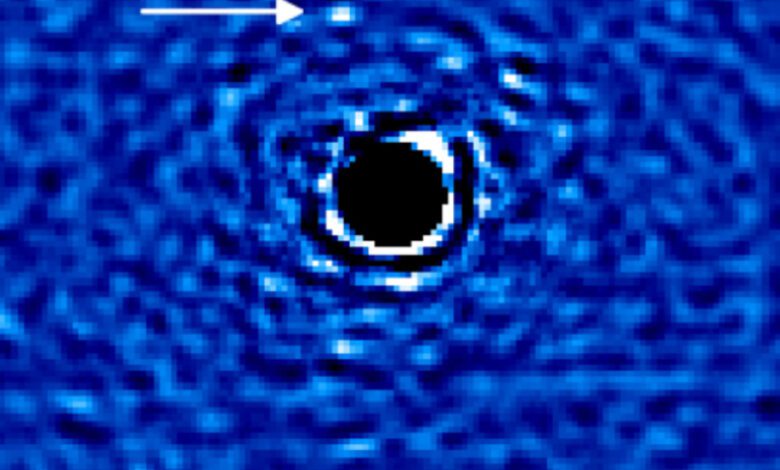
The Spanish scientific community is abuzz with excitement: a team of astronomers, using ground-based telescopes, has managed to directly detect an exoplanetary giant orbiting the young binary star system HD 143811 AB. This discovery has caused a real sensation, as it marks the closest orbit ever found among all known exoplanets in multi-star systems. Nine years of painstaking observations, data analysis from various instruments, and continuous verification allowed scientists to conclude: this is not just a background object, but a giant planet gravitationally bound to the system.
HD 143811 AB is located in the Scorpius–Centaurus star-forming region and consists of a pair of stars, each slightly more massive than the Sun. Their age is estimated at just 13–15 million years—cosmically speaking, they’re practically infants. The stars orbit each other every little more than 18 days, while the detected giant exoplanet completes one full orbit every 320 years. Its mass is estimated between 4.9 and 6.2 times that of Jupiter, and its surface temperature reaches up to a thousand Kelvin.
The use of adaptive optics and a coronagraph allowed astronomers to block out the bright starlight and focus on the faint companion. The unusual object in the system was first discussed back in 2016, when a faint light source appeared in observational data. Since then, scientists have closely monitored its movement to rule out the possibility of a random coincidence or a background object. The result: there is now confidence that the exogiant truly belongs to the HD 143811 AB system and moves in a multiple orbit with an inclination of 37.5 degrees and an eccentricity of 0.23.
Rarity of the discovery
Such discoveries are extremely rare. Of the more than six thousand known exoplanets, only a handful have been found in systems with two or more stars. The reason is simple: the conditions for forming and sustaining planets in such systems are much more complex than in single-star environments. Astronomers distinguish between two types of orbits for these bodies: S-type, where the planet orbits one of the stars, and P-type, where it orbits the entire system as a whole. In the case of HD 143811 (AB) b, we are dealing with a multiple orbit, which makes the discovery even more valuable for theories of planet formation.
Until now, most exoplanets discovered in multiple star systems have been found on very wide orbits, often at the boundary between planets and brown dwarfs. Direct observations of such objects are extremely rare, as they require specific conditions: a young system, sufficient brightness, and minimal interference from background sources. Spanish astronomers, using the GPI instrument on the Gemini South telescope, SPHERE on the VLT, and NIRC2 at the Keck Observatory, have managed to collect a unique set of data that not only confirms the existence of the exogiant, but also provides a detailed description of its characteristics.
Scientific significance
The discovery of HD 143811 (AB) b raises new questions for scientists. How do such massive planets form in close multiple star systems? What processes determine the evolution and orbital stability of these worlds? Researchers are now working to find out whether the ‘cold start’ model—where a planet forms through the accretion of material onto a solid core—applies here, or if the ‘hot start’ scenario—gravitational instability in the protoplanetary disk—played a role. The answers to these questions could reshape our understanding of how planets form in complex stellar environments.
Interestingly, until now scientists had only managed to discover a few exoplanets orbiting binary stars within a single system—Kepler-47, where three planets revolve around a pair of suns. This new Spanish discovery not only expands the list of known objects but also sets a new benchmark for future research. Astronomers will now closely monitor HD 143811 AB to determine how unique this system is and whether similar discoveries can be expected in the coming years.
Technologies and Methods
For this project, Spanish specialists employed the most advanced observation techniques. Adaptive optics helped compensate for distortions caused by Earth’s atmosphere, while coronagraphic masks effectively blocked starlight, making it possible to study faint satellites. This approach requires not only technical capabilities, but also a highly trained team able to analyze vast amounts of data and detect even the slightest anomalies.
Nine years of collected data not only confirmed the existence of the exogiant, but also allowed scientists to track its orbital path and estimate its mass, radius, and temperature. This discovery was made possible thanks to close collaboration among various observatories and research centers, as well as support from national and international research programs.
Looking Ahead
In the coming years, Spanish astronomers plan to continue observing HD 143811 AB and its exogiant. New data will help refine the planet’s orbital parameters, reveal possible changes in its movement, and may even uncover additional objects within the system. Additionally, the results obtained will form the basis for developing new theories on planet formation in multi-star systems, which could lead to a revision of existing models and the emergence of unexpected hypotheses.
The emergence of such discoveries highlights the importance of investing in astronomical research and the development of advanced observational technologies. Spain continues to strengthen its position in global science, demonstrating the ability to tackle the most complex challenges and contributing to our understanding of the structure of the Universe.
In case you didn’t know, HD 143811 AB is a young binary star located in the Scorpius–Centaurus region, which has long attracted astronomers’ attention due to its unusual characteristics. In recent years, Spanish research centers have been actively involved in international projects focused on the search and study of exoplanets, utilizing cutting-edge telescopes and data analysis methods. The discovery of the exogiant in a close orbit was the result of years of work and collaboration among the country’s leading observatories. Achievements like these strengthen Spain’s scientific reputation and open new horizons for future astronomical research.