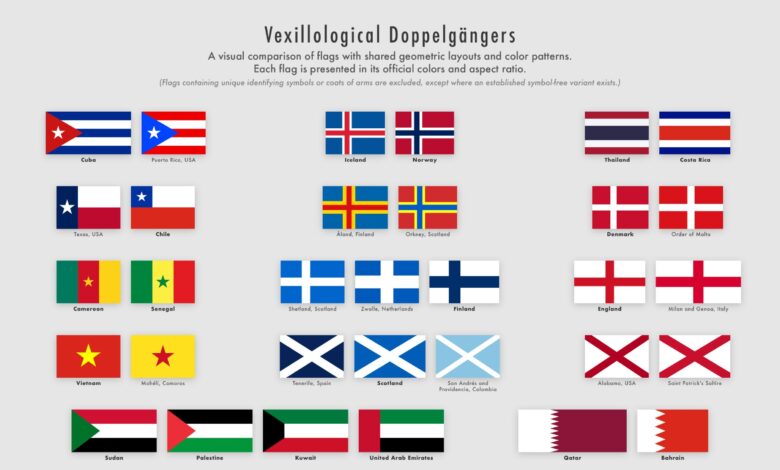
There are many national and regional flags in the world, and some are so similar that even experienced observers can easily confuse them. The reasons for such similarity vary widely: from historical connections to mere coincidences in the choice of colors and shapes. Sometimes the resemblance is explained by shared cultural roots, and other times it’s simply a matter of designers sharing similar tastes and preferences. In any case, such coincidences attract the interest of vexillology experts and ordinary enthusiasts alike.
Recently, a data visualization enthusiast created a detailed infographic featuring pairs and groups of flags that are nearly indistinguishable from one another. The selection includes both national and regional flags that share the same color schemes and element layouts. The author tried to avoid cases where the only difference is the presence of a coat of arms or another symbol, unless the official version of the flag allows for its absence.
The infographic shows that similar flags can be found not only among neighboring countries but also among those separated by thousands of kilometers. For example, tricolors with identical stripes or crosses appear in Europe, Africa, and even in the islands of Oceania. This vividly illustrates that visual symbols can emerge independently in different parts of the world.
Historical reasons and cultural parallels
The similarity of flags is often explained by historical events. For example, many former colonies adopted elements of the symbols of their metropolises. For instance, the flags of Australia and New Zealand feature the British Union Jack in the upper left corner, though they differ in certain details. However, these countries are not included in this infographic, as their flags are distinguished by the number and shape of the stars.
In other cases, similarities arise from shared ideas and values. Red, white, and blue, for example, are often associated with freedom and revolution, which is why these colors appear on the flags of France, the Netherlands, Russia, Serbia, and many others. Sometimes, states with no historical connection end up with similar flags, simply because they were inspired by the same symbols.
Geometry and Color: How Flag Lookalikes Are Created
The author of the infographic carefully selected pairs of flags so they matched not just in color, but also in the arrangement of stripes, crosses, or other elements. Flags were excluded if their differences were only in details such as shades or additional symbols. Exceptions were made only for cases when the official version of the flag permits the absence of a coat of arms or emblem.
Interestingly, even with strict selection, there are quite a few countries and regions whose flags look nearly identical. This applies not only to national symbols but also to the flags of individual territories, cities, or autonomous regions. This approach allows for a broader perspective on the issue and reveals how diverse yet remarkably similar the world of state symbols can be.
The Impact of Globalization and Current Trends
In recent decades, globalization has led countries to increasingly adopt universal symbols and colors. This is reflected in their flags: new nations or regions often choose existing color schemes to emphasize their belonging to a particular cultural or political group. As a result, new ‘twins’ emerge, further expanding the collection of similar flags.
Yet, even when flags appear similar on the surface, each one remains unique to its country or region. The symbolism embodied in their colors and shapes reflects the history, traditions, and values of the people. That’s why even the most similar flags hold their own special meaning and are perceived differently depending on the context.
By the way, who is M. Lazear
The creator of the infographic, known as M. Lazear, is recognized in the English-speaking Reddit community for his work in data visualization and infographics on a variety of topics. His projects often gain popularity due to their original approach and attention to detail. Lazear has repeatedly published infographics dedicated to flags, geography, and the cultural features of different countries. His work is distinguished by thorough analysis and a commitment to making complex information accessible to a wide audience. Thanks to this, M. Lazear has earned a reputation as an expert in visual data and has become one of the prominent figures in the contemporary infographics movement. His compilations are regularly discussed in specialized communities and are used as illustrative material for educational purposes.
Previously, we highlighted an unusual photograph depicting a skydiver crossing the solar disk. This shot was captured by an American photographer using a sophisticated technique and meticulous preparation. Read more about this event in our article “Rare Shot: Skydiver Crosses the Solar Disk in Astrophotographer’s Lens”.