In the heart of Madrid’s Chamartín district, you can still smell fresh wood and lacquer. Hidden away at 19 Infanta María Teresa Street is the Margharetta workshop—a place where time seems to stand still. Here, surrounded by wood shavings and old photographs, 22-year-old Alba Puente unexpectedly found herself running the family business, which will celebrate its 50th anniversary in 2026.
I first stumbled into Margharetta by chance, but I immediately realized this was more than just a frame shop. Every corner is infused with family history—three generations working side by side. Alba is the granddaughter of the founders, María del Pilar Isern and Teófilo Sastre. The workshop opened in 1976, and little did they know their business would outlast decades and become a true neighborhood legend.
The family business has passed through the hands of all seven children of the founders. Some handled the paperwork, others worked in the shop, but each one left a piece of themselves here. Alba’s mother, Marien Sastre Isern, took over after her own mother passed away in 2015. Now, as her mother’s health has declined, Alba didn’t hesitate to step up and take charge.
The power of tradition
Margharetta isn’t just a workshop—it’s a community landmark. Even after moving a few streets away, loyal customers keep coming in to catch up or reminisce about old times. Every other passerby here knows Alba by name, and many still remember her grandparents.
The workshop has a unique atmosphere: cozy, unhurried, with deep respect for the craft. Alba admits she can’t imagine herself outside these walls. For her, Margharetta is home—a place where she grew up surrounded by the scent of wood and the voices of her relatives. Neighbors often drop by just to chat or share memories of years gone by.
Although times have changed, demand for handmade work remains strong. Alba is convinced that people still value a personal touch and a level of quality you can’t find in big stores. Here, you can frame not only photos or paintings but also the most unexpected items—from T-shirts to medals and crosses.
Craft and Challenges
Working at Margharetta isn’t just about making frames. It’s about meticulous attention to detail, patience, and the desire to make every item unique. Alba proudly notes that the workshop offers hundreds of framing options: double matting, glass inserts, deep-set frames. Every order is a story of its own, and the client is always part of the process.
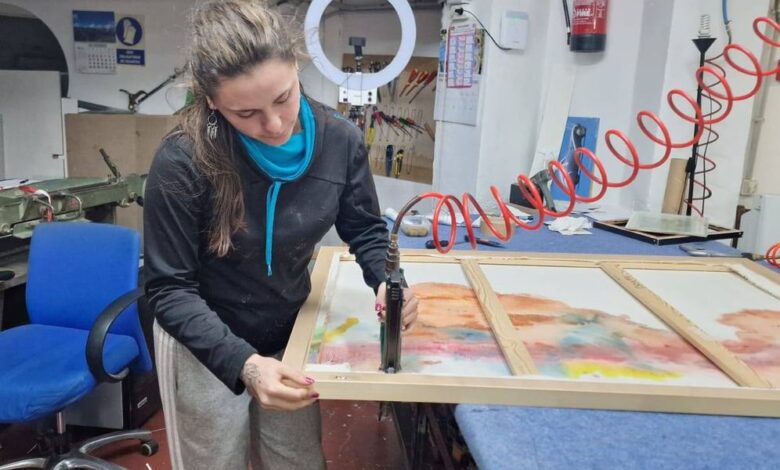
Three women work in the shop: Alba herself, Sofia, who greets clients, and Ana, responsible for technical operations. Every step—from sawing three-meter boards to assembling and stretching canvases—takes place here, right before the customer’s eyes. Sometimes time feels short, but the team manages even the toughest tasks.
Prices at Margharetta vary: you can choose exclusive, high-end options or more affordable solutions. The main focus is quality and a personalized approach. Alba is upfront: their work can’t be as cheap as in hypermarkets, but the difference in the result is immediately noticeable.
New horizons
Alba isn’t afraid of change. She actively promotes the workshop on social media to attract a younger audience. According to her, most clients are 40–50 years old, but increasingly, young people who appreciate a unique approach and the chance to give a gift with a story are showing interest.
Young people are used to speed, but even here Margharetta keeps up: standard orders are completed within a day, and during the holiday rush—no longer than two weeks. Alba believes that craftsmanship should move with the times, without losing its soul.
She admits that sometimes she wishes clients would value handmade work more. But there are always those who choose quality and individuality. Thanks to Alba’s efforts, the workshop is gradually becoming popular with the new generation.
A personal choice
Until recently, Alba was studying a double major in law and criminology. But when her mother fell ill, she didn’t hesitate to leave her studies behind and devote herself fully to the family business. It turned out that working in the workshop brought her far more joy than the prospect of a legal career.
Time seems to fly here. Alba doesn’t rule out that her future may be with Margharetta rather than in law. She dreams of preserving the family atmosphere even 50 years from now, no matter how modern the workshop becomes. The most important thing is not to lose that special spark that makes this place unique.