In the heart of Kenya’s Laikipia region, amidst the endless savannah, a unique tourist complex—Suyian Lodge—has emerged. Its creators set themselves an ambitious goal: to offer guests the highest level of service while causing minimal impact on the fragile ecosystem. The project is the result of a collaboration between British and South African architects, who aimed not to conquer the natural world, but to become an organic part of it.
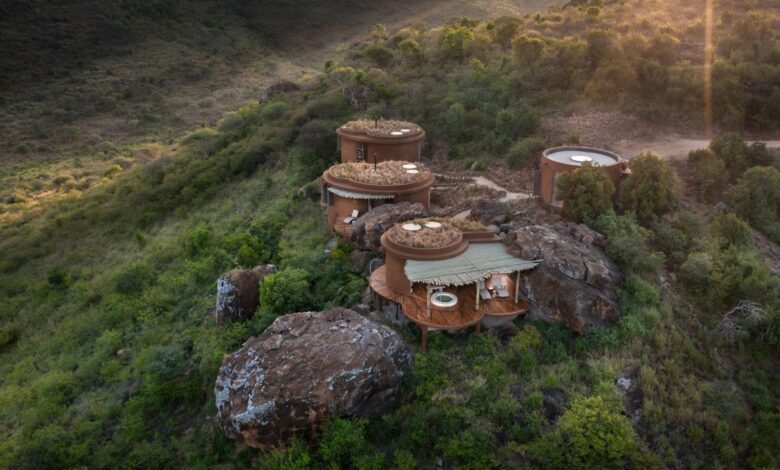
The core philosophy of the complex is complete harmony with the landscape. Instead of rising above the terrain, the buildings are delicately integrated into rocky outcrops and native vegetation. The architects explain that their goal was to make it feel as though the living spaces were not constructed, but gently carved into the very landscape. To achieve this, they used lightweight structures, locally sourced natural materials, and low-carbon building technologies.
The residential villas and communal areas are scattered among granite boulders, centuries-old trees, and natural trails. Their organic, flowing shapes encourage natural air circulation, significantly reducing the need for air conditioning and electricity. Huge floor-to-ceiling panoramic windows erase the boundary between the interior and the outdoors. This allows guests to observe wildlife without leaving their rooms or disturbing the natural rhythms of the savannah’s inhabitants.
The entire project was carried out in close collaboration with the local community. One of the main goals was to preserve traditional grazing lands and the migration corridors used by elephants and other large animals. As a result, communal spaces such as the restaurant and lounge areas were built on elevated platforms, offering breathtaking views. Pedestrian paths connecting the villas were laid out to avoid intersecting with wildlife routes.
Special attention was also given to landscaping. Instead of finicky imported plants, only local, drought-resistant species were planted. This approach not only reduces the need for irrigation but also more deeply integrates the resort into the natural cycles of the local ecosystem.
This resort is a vivid example of blending modern vision with ancient wisdom. Its aesthetic clearly reflects the influence of Samburu artisans, whose deep knowledge of the land formed the basis for many design decisions. Furniture, lighting, textiles, and decorative elements were handcrafted by local craftsmen using traditional techniques rarely found in large-scale tourist projects.
This partnership serves a dual purpose. On the one hand, it provides economic support to the local population by creating jobs and opening up a market for artisanal products. On the other, it offers guests the opportunity to truly immerse themselves in a culture that has been shaped in this region for centuries. The project’s creators emphasize that they sought to infuse every detail with history, crafting an atmosphere that cannot be replicated anywhere else.
Guests are offered more than just safari tours. The lodge features communal spaces where you can take part in workshops, meet local herders, or listen to elders share stories about the mystical connection between people and the savannah. The concept aims to develop a form of tourism that goes beyond wildlife watching, allowing visitors to understand the complex social fabric that sustains these animals.
Since the complex operates in a region where balancing livestock farming and conserving megafauna is a pressing issue, part of the proceeds goes towards funding predator protection programs and assisting nomadic tribes. The project’s initiators believe that sustainable tourism is only possible when local residents become its main protagonists, not passive observers.