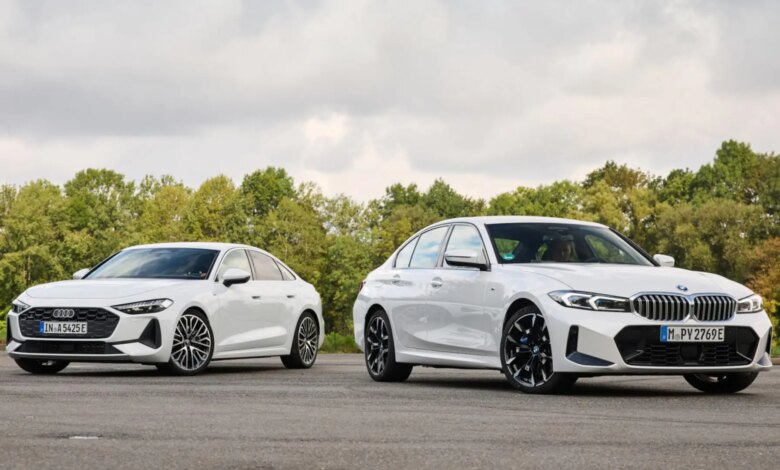
Two German heavyweights — Audi and BMW — are once again going head-to-head, but this time on the hybrid technology battlefield. Their latest sedans with plug-in hybrid engines not only save fuel but also get your heart racing. By 2026, the question isn’t whether to choose a hybrid, but which one delivers more excitement and practicality.
This duel features the Audi A5 e-hybrid quattro and the BMW 330e xDrive. Both cars promise not only eco-friendliness but also the driving pleasure once reserved for gasoline engines. But do they live up to these expectations?
Technology and engines
Both sedans come equipped with two-liter turbocharged engines paired with electric motors. Audi offers a combined output of 299 hp, while BMW delivers 292 hp. The difference seems minor, but in practice, each brand harnesses this potential in its own way.
The BMW 330e xDrive features a classic eight-speed automatic transmission that responds instantly to the throttle. Audi, on the other hand, relies on a dual-clutch robotized transmission, delivering sharp starts and lightning-fast shifts. In real-world driving, the difference in dynamics is minimal, but the driving experience feels completely different.
Top speed is another trump card for Audi, putting it noticeably ahead of its rival. However, BMW strikes back in other areas, such as the smoothness of its transmission and the predictability of its on-road behavior.
Performance and handling
In corners, the Audi feels lighter than it actually is, despite being almost 180 kg heavier. Its steering is more responsive, and body roll is minimal. The BMW, on the other hand, delivers sportier handling with a slight tendency for the rear axle to slide out, which driving enthusiasts will especially appreciate.
Audi excels in sound insulation: the engine is barely audible even under hard acceleration. BMW counters with a smoother, steadier engine tone at high revs. The Audi’s suspension handles large bumps better, while the BMW deals more effectively with minor road imperfections.
Both cars deliver excellent braking performance, but the Audi feels slightly more confident during emergency stops, especially after prolonged strain.
Electric potential
In electric mode, both sedans can travel over 80 kilometers on a single charge: Audi up to 96 km, BMW up to 83 km. Charging is possible from an 11 kW wallbox, allowing quick energy replenishment.
Both energy recuperation systems are smartly engineered: they analyze terrain and route to maximize every kilowatt. Fuel consumption in the combined cycle is surprising—despite nearly 300 hp, both cars remain impressively efficient.
Interior and comfort
Inside, both sedans greet driver and passengers with modern digital panels and large curved screens. BMW features vertical instrument clusters, while Audi has its signature arched layout. The information layout takes some getting used to, but it looks impressive.
The front seats in the Audi offer excellent ergonomics and impressive lateral support. BMW keeps pace: its seats are comfortable, with neat stitching and well-designed ergonomics. In the second row, BMW feels a bit tighter due to larger wheel arches, but the seat profile ensures good comfort on long journeys.
Audi’s trunk is compromised by the battery placement—usable space ranges from 331 to 1175 liters. BMW’s trunk is smaller at 371 liters, and access is limited by a narrow opening. In terms of versatility, Audi comes out on top, but BMW wins with its superior interior finish.
Final notes
In the final score table, the gap between the rivals is minimal. The Audi A5 e-hybrid quattro impresses with its engine’s responsiveness and agility, but it’s also more expensive and does not always justify the price difference. Despite slightly less power, the BMW 330e xDrive matches it in performance and, all things considered, is a more advantageous choice for those who value a balance of comfort, driving experience, and efficiency.
Audi is one of Germany’s leading automakers, founded in 1909. The company is renowned for its innovations in safety, design, and technology. BMW, since 1916, has produced cars that are seen as the benchmark for handling and style. Both brands are actively developing hybrid and electric technologies, aiming to maintain their leadership in the global premium car market.