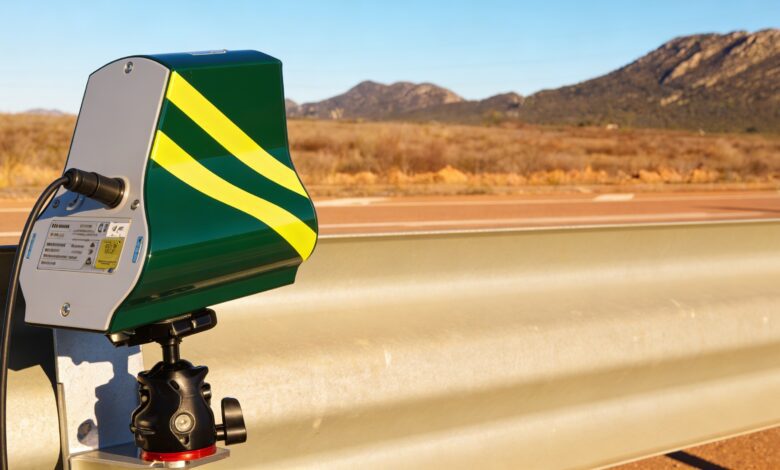
Spanish drivers will face a new level of road monitoring as the DGT introduces discreet laser speed cameras ahead of Easter. These devices can detect speeding from up to a kilometer away. Their compact size and ability to be hidden make them nearly undetectable for most motorists. As a result, the risk of receiving a fine increases even for those who rely on familiar fixed cameras or navigation app warnings.
Unlike traditional speed cameras, the new Velolaser systems and their counterparts can be installed in unexpected locations: on barriers, road signs, small tripods, or even inside patrol vehicles. This allows DGT inspectors to quickly change the devices’ positions, making it impossible to know control points in advance. According to RUSSPAIN.COM, the mobility and stealth of these radars are the main factors behind the rise in detected violations.
The technologies used in new devices not only allow speed to be measured with high precision but also enable several photos to be taken per second. This ensures clear capture of a vehicle’s license plate and streamlines the process of issuing fines. Additionally, the high image quality makes it difficult to contest a violation, as the evidence becomes highly visual. Drivers accustomed to older methods of avoiding fines now face a real risk of being caught even on empty stretches of the road.
Mobility and camouflage
The main advantage of the new radars is their small size and the ability to install them almost anywhere. Previously, drivers could spot large stationary cameras in advance, but now, even on long, straight stretches of road, it is hard to determine exactly where the device is hidden. Such devices are especially often placed where drivers tend to exceed speed limits—on flat and extended roads where it seems that control is minimal.
Mobile radars are easy to relocate, allowing officers to change monitoring points several times a day. This makes it impossible to create up-to-date warning maps in popular apps like Google Maps or Waze. Even if someone does spot a new radar, by the time the information appears online, the device may already have been moved to another location.
In addition, the compact size allows these radars to be integrated into patrol vehicles, adding an element of surprise. Drivers who are used to spotting external signs of enforcement now have to stay alert on every part of the road.
Surveillance technologies
As part of enhanced monitoring, the DGT uses not only invisible radars but also other modern surveillance tools. The agency operates 15 helicopters capable of detecting violations at speeds up to 350 km/h and at altitudes up to 700 meters. These aircraft are especially effective for tracking reckless drivers on high-speed highways, where ground patrols cannot always respond in time.
The system is complemented by nearly 40 drones, more than half of which can independently detect violations and issue fines. Drones are less conspicuous than helicopters and can operate at just over 100 meters, making them ideal for covert monitoring of difficult road segments. However, their autonomy is limited—usually no more than one hour. As a result, drones are used selectively and in the most problematic zones.
Together with invisible radars, these technologies form a unified monitoring system covering both major highways and secondary roads. This approach makes it possible to detect violations not only in traditionally dangerous locations but also in places where control was previously minimal.
Expanding monitoring
Ahead of Easter, the DGT is stepping up the operation of all types of speed cameras: fixed, mobile, section, and covert devices. Special attention is being given to areas with heavy traffic and accident-prone locations. New units are being installed not only on major highways but also on secondary roads, increasing the likelihood of catching violations even in sparsely populated areas.
As part of a special traffic safety operation, officers are actively deploying all available tools to reduce accidents and improve driver discipline. According to russpain.com, the introduction of new technologies has already led to an increase in detected violations, which in turn raises revenue from fines for the budget.
Drivers should keep in mind that common tricks to avoid fines are becoming less effective. New radars and surveillance systems operate almost flawlessly, and their mobility and concealment make detection nearly impossible. As a result, even experienced motorists risk being caught if they do not observe speed limits.
DGT (Dirección General de Tráfico) is Spain’s national agency responsible for traffic management, enforcing road regulations, and implementing new safety technologies. In recent years, the agency has heavily invested in modern monitoring systems, including mobile and concealed speed cameras as well as aerial surveillance. These efforts have led to a significant rise in detected traffic violations across the country and a gradual improvement in driver discipline.