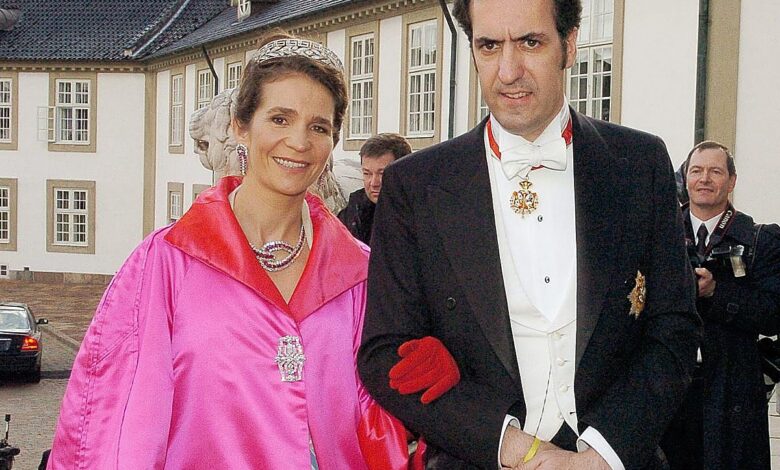
Among the many jewels worn by Infanta Elena, the Marichalar tiara holds a special place. She wore it when she married Jaime de Marichalar in Seville in March 1995. Throughout their marriage, this diadem accompanied Elena at official receptions and major events, becoming her distinctive accessory. Unlike other members of the dynasty, she declined the historic Bourbon tiaras and instead chose a piece created by the jeweler Ansorena in the 1920s. This choice was not accidental: the tiara served as a tribute to María de la Concepción Sáenz de Tejada, Jaime’s mother and the widow of the Count of Ripalda.
The Marichalar tiara is a triple diadem inspired by ancient Greece. Made of platinum and set with diamonds, its design allows it to be separated into individual elements. For a long time, it was believed that the tiara was a gift from the Marichalar family to Infanta Elena for her engagement, but today this fact is in doubt. After Elena’s divorce, the tiara did not disappear: it now graces the heads of new brides in the Marichalar family, continuing its legacy.
Details and symbolism
The uniqueness of the tiara lies in its design. The platinum base is adorned with circular elements that the Infanta sometimes removed. The central part is shaped like laurel leaves, while the top features Greek meanders, giving the piece a sophisticated elegance. All the components can be worn together or separately, making the tiara highly versatile. Experts estimate its value at around 80,000 euros. For Elena, this was the only tiara she wore throughout her marriage.
Before her wedding, the Infanta preferred other family heirlooms: the Prussian tiara belonging to her mother, and a floral diadem gifted by Franco for Sofía’s wedding. Another of her favorite pieces was the Greek circles tiara, owned by Princess Irene of Greece, Queen Sofía’s sister. Elena wore this diadem at the ball ahead of the wedding of Prince Alois of Liechtenstein.
Wedding traditions
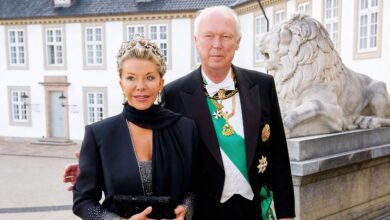
After her marriage, Infanta Elena regularly wore the Marichalar tiara at official banquets in the Madrid Royal Palace. Among the most notable occasions were the 1999 dinner in honor of the King and Queen of Jordan and the 2006 reception for the President of Portugal. The tiara also accompanied Elena to two high-profile royal weddings: Crown Prince Frederik of Denmark and Mary Donaldson in 2004, and Crown Princess Victoria of Sweden and Daniel Westling in 2010. At the latter ceremony, which took place six months after her official divorce, Elena wore the tiara for the last time.
The tiara has become an integral part of the Marichalar family’s wedding traditions. In 1957, María de la Concepción Sáenz de Tejada wore it for the first time at her wedding to Amalio de Marichalar. Later, the diadem adorned the head of their daughter Ana at her marriage to Luis Coronel de Palma in 1989. In 2018, Ana’s granddaughter — Ana Coronel de Palma y Marichalar — tried on the tiara, using the laurel leaves as hairpins and the meanders as a necklace. In 2020, the piece reappeared at the weddings of Inés and Blanca de Marichalar, daughters of the current Count of Ripalda.
The future of the tiara
Today, the Marichalar tiara remains a symbol of continuity and family values. With each new generation, it gains new meaning, becoming part of each bride’s personal story. It is quite possible that in the coming years, the tiara will make another public appearance — this time atop the head of Victoria Federica de Marichalar y Borbón, daughter of Infanta Elena and Jaime de Marichalar. This family heirloom, which has endured for decades, continues to attract interest and admiration from fans of royal traditions.
The Marichalar tiara is more than just a piece of jewelry — it is a living chronicle of the family, with each bride writing her own chapter. Its story is not only about diamonds and platinum, but also about continuity, memory, and new beginnings.
In case you didn’t know, Infanta Elena is the eldest daughter of King Juan Carlos I and Queen Sofia, and holds the title of Duchess of Lugo. Jaime de Marichalar, Elena’s former husband, comes from an old Spanish aristocratic family. The Marichalar tiara is considered one of Spain’s most recognizable family jewels and often becomes a topic of discussion among royal enthusiasts.