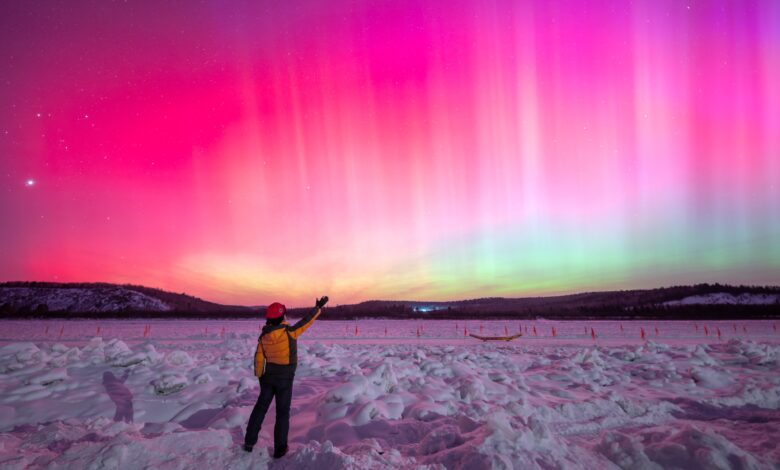
The night of January 19-20, 2026, went down in history as one of the most spectacular for astronomy enthusiasts. For the first time in many years, people across the world’s mid-latitudes witnessed a stunning event: the sky was illuminated by bursts of the aurora borealis, a phenomenon usually confined to the polar regions. The reason behind this spectacle was an exceptionally powerful geomagnetic storm that reached level G4, which is classified as a severe geomagnetic disturbance on the international scale.
For several hours, Earth’s atmosphere remained in a state of chaos. The northern lights, like a giant curtain, stretched from Germany all the way to the southwestern United States, even reaching unexpected places such as New Mexico. Social media was instantly filled with hundreds of photos and videos showing colorful waves and pillars of light dancing above cities and towns, leaving millions of people in awe and amazement.
Experts note that such a large-scale phenomenon became possible due to an extraordinarily fast coronal mass ejection from the Sun just a day before the event. This solar storm, accompanied by an X1.9-class flare, traveled to Earth at record speed, causing a dramatic increase in the planet’s magnetic field and triggering a storm no one expected.
Where the aurora was seen
Spectacular footage has emerged from across the globe. In Germany, photographer Florian Gaertner captured green and red waves reflecting over the Müggelspree river. In Hungary, the village of Abaujvar was wrapped in crimson and emerald flashes, photographed by Robert Nemeti. French photographer Jerome Gilles caught mysterious purple shimmers over Bretagne on camera, while in China, Chi Shiyong witnessed incredibly vibrant auroras in the village of Beiji, Heilongjiang province.
North America was no exception either. Greg Gage from Deming, New Mexico, shared images showing the aurora clearly visible at latitude 32°, which is remarkable in itself. In Canada, Alex Masse documented towering light pillars, while in Ontario and Bretagne, entire time-lapse series showed how the sky changed minute by minute.
Causes and consequences
According to experts, such a powerful geomagnetic storm was triggered by a coronal mass ejection that hit Earth just 24 hours after a solar flare. Normally, these phenomena unfold more gradually, but this time the CME (coronal mass ejection) reached a record speed. By 21:38 GMT on January 19, geomagnetic indices spiked to G4 levels, instantly producing auroras at unusually low latitudes.
Throughout the night, geomagnetic activity levels fluctuated from moderate to extreme, creating conditions for repeated bursts of aurora that would fade and then reappear with renewed strength. Meteorological agencies in the UK and US warned of potential disruptions to radio communication and navigation systems, but it was mainly the atmosphere that bore the brunt—millions of people had the chance to witness this rare natural spectacle.
Eyewitness accounts
The excitement was shared not only by professional photographers but also by ordinary residents. Social networks were flooded with photos and videos showing the aurora painting the sky crimson, green, violet, and even golden. Many admitted they had never seen anything like it, and some didn’t believe their eyes at first, thinking it had to be an optical illusion or the result of city lights.
The aurora appeared especially vivid in rural areas untouched by light pollution. Even in cities, despite streetlights and neon signs, the displays were so powerful they couldn’t be missed. In some regions, families poured onto the streets together, unwilling to miss the chance to witness such a unique phenomenon.
What’s next
Experts predict that geomagnetic activity will gradually decrease, but the chance of new solar flares remains. Astronomers recommend keeping aurora alerts on and cameras ready—if the solar wind intensifies again, the show could return over the next few nights.
At the same time, scientists emphasize that such powerful geomagnetic storms can affect not only the beauty of the night sky, but also the operation of satellites, power systems, and even the health of people sensitive to atmospheric changes. Both specialists and ordinary observers are closely monitoring the situation as it develops.
RUSSPAIN reminds readers that the aurora is a glow in the upper layers of the atmosphere, occurring when solar wind interacts with Earth’s magnetic field. Usually, it’s only visible at high latitudes, but during strong magnetic storms, auroras can reach as far as the southern regions of Europe, Asia, and North America. Such events are extremely rare and always spark strong interest from both scientists and the public.