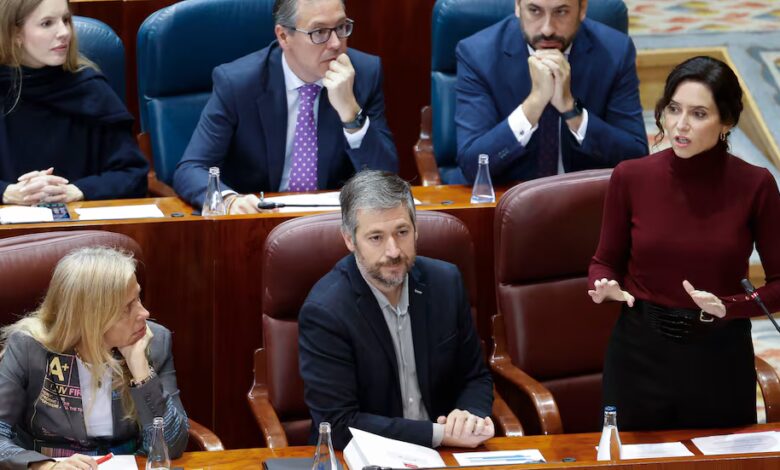
This Thursday, the Madrid Assembly once again found itself at the center of national attention. For the third week in a row, deputies are debating issues resonating widely across Spain. This time, the focus is on corruption investigations as well as the personal life and decisions of the regional president.
Corruption investigations and new revelations
On the agenda is a recent report by the Central Operative Unit (UCO), featuring documents, photos, and intercepted communications from former high-ranking officials. Among them are Santos Cerdán, the former Socialist leader recently released from prison, and former minister José Luis Ábalos. The new evidence has heightened suspicions of their involvement in corruption schemes, sparking a strong response from both deputies and the public.
The personal life of the regional president under scrutiny
On the same day, it emerged that Alberto González Amador, the partner of the Madrid president, had purchased a luxury penthouse that the couple had previously rented for a considerable sum. The deal, worth over one million euros, had long been the subject of speculation due to a lack of transparency. Additionally, Amador owns another apartment in the same building, acquired after an alleged tax offense of 350,000 euros, for which he is set to face trial.
Allegations against the attorney general and regional disputes
The country’s attorney general is under investigation for allegedly disclosing information related to the González Amador case. Specifically, this concerns the publication of an email in which the entrepreneur’s lawyer allegedly admits to tax offenses.
Regional challenges: education, healthcare, and historical memory
Beyond headline-grabbing scandals, lawmakers are also debating strictly regional issues. Representatives of opposition parties — PSOE, Más Madrid, and Vox — are demanding that the president clarify the lawsuit against the new government decree on the establishment of universities. According to regional authorities, this decree infringes on Madrid’s autonomous powers. The state of the healthcare system and the failure of regional authorities to implement the historical memory law are also recurring topics of debate.
Thus, the Madrid Assembly session became a battleground for both national and local issues, reflecting the tense political climate in Spain.