The idea was hers, not that of her newlywed husband Alex Grushinski, yet the entire celebration looked as if it had been lifted straight out of an American Halloween party script. I’ll try to be forgiving, as she does have a hint of the touching innocence of a young Banderas from Almodóvar’s ‘Women on the Verge of a Nervous Breakdown.’ Still, I’m convinced that even those divine eccentrics from that famously ‘typically Spanish’ film would have been stunned with horror if they had found themselves at this tragicomedy unfolding in the restrained and noble Castile.
There were bright moments as well. First and foremost, the bride’s genuine affection for Spain shone through all this theatrical pomp. Setting criticism aside, her face was beautiful: gentle features reminiscent of the holy maidens painted by Spanish masters, skillful makeup, and natural curls softened her overall appearance. Her innocent desire to honor her father’s homeland by choosing Spanish lace and holding the ceremony on Spanish soil deserves praise. And of course, the bride’s father. Antonio Banderas is our national treasure, just like our entire culture. He looked elegant and radiant with happiness as he gave his daughter away on his own land. His polite engagement with the press at the gates of the estate, turned into a fortress for exclusive filming rights, only added to his charm.
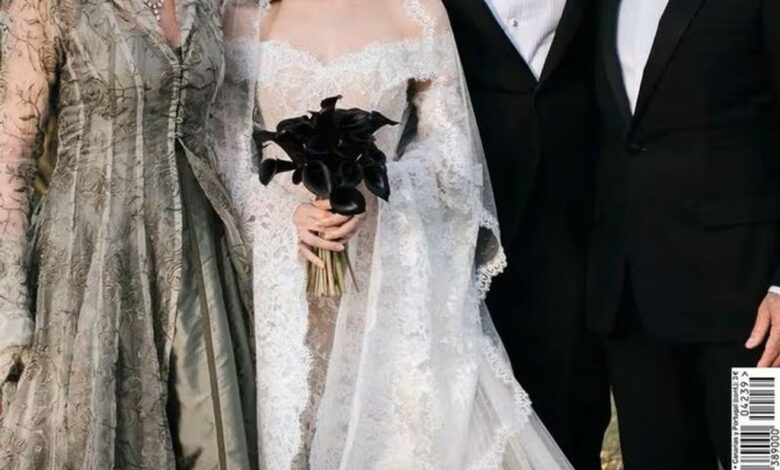
However, there were far more missteps. Let’s start with the bride herself. Her excessive romanticism resulted in a gothic staging that resembled more of an American show. If all that lace had been incorporated into a simpler, less flamboyant dress rather than a ‘mega-mermaid’ outfit, the look would have been much more delicate. I was horrified by her black calla lilies—a choice as dreadful as Pilar Rubio’s infamous bouquet at her much-talked-about wedding in the Seville Cathedral. A bride at the altar should not be holding black flowers, as if foreshadowing misfortune.
The groom also failed to impress. His casual attitude made it seem as though he hadn’t even bothered to wash his hair after the pre-wedding party or properly iron his shirt. The bride’s mother, Melanie Griffith, also embraced the gothic theme with her overdone green outfit, desperately trying to maintain the image of the youthful infanta Antonio once fell in love with. Despite the terrible outfit, she still evokes sympathy and tenderness.
But the darkest note came from the bridesmaids. This isn’t the title of a thriller, but a description of a group of women, including the bride’s sister Dakota Johnson, dressed in somber black lace. They resembled a procession of Castilian mourners at the funeral of a wealthy but simple landowner. Their bouquets of black and red flowers evoked pain and blood, rather than union and new life. All this turned the wedding into something closer to a 12th-century witch’s sabbath than a true Spanish celebration in the divine temple of art, architecture, and gastronomy that is the Retuerta Abbey. And yet—long live the bride! I’ll say it loudly and clearly. And long live her sense of being Spanish, despite her American spirit and the tasteless tinsel brought from across the ocean.