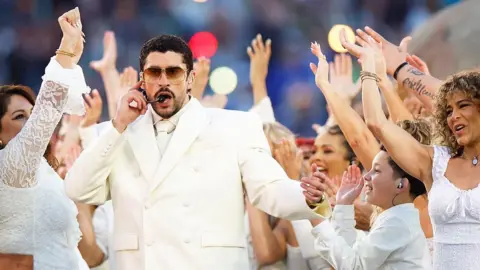
The 2026 Super Bowl will be remembered not only for its sporting drama but also for a cultural explosion: Bad Bunny, the world’s most-streamed artist, made history by delivering America’s biggest music show entirely in Spanish for the first time ever. His performance was more than just a concert—it became a true manifesto of Latin American pride and unity, sparking a wave of emotion and debate on both sides of the Atlantic. The spotlight was not only on music and dance, but also on sharp political references that did not go unnoticed by either viewers or the former US president.
Puerto Rico, the artist’s homeland, became the heart of the show: the stage was transformed into a colorful street with a traditional casita, sugarcane field, bar, and beauty salon. Bad Bunny went beyond music—he brought an all-star lineup onstage: Lady Gaga, Ricky Martin, Cardi B, Pedro Pascal, and Jessica Alba appeared in unexpected roles, and their joint dances and vocal duets gave the show a special energy. Every detail was carefully planned, from the flags of American countries to slogans of love and unity flashing across screens and accessories.
At the height of the celebration, Bad Bunny uttered his only phrase in English — ‘God bless America,’ then listed the countries of the Americas as dancers carried their flags across the stage. In the background, a call for solidarity sounded: ‘Together we are America.’ A special moment came with the scene of a young boy receiving a Grammy and a symbolic climb up a power line, referencing the tragedy of Hurricane Maria, which devastated Puerto Rico’s infrastructure. The performance was filled with allusions to pain and hope, and a sweater with the number 64 evoked memories of lives lost to the disaster.
Reaction and controversy
However, not everyone saw the show as a celebration. Donald Trump, who was not present at the stadium, reacted instantly on social media, calling the performance ‘absolutely terrible’ and ‘an insult to the greatness of America.’ According to him, the audience could not understand a word, and the show itself was ‘one of the worst in history.’ In response to the official event, Trump supporters organized an alternative concert featuring Kid Rock, sharply highlighting the divide within American society over identity and cultural values.
Nevertheless, Bad Bunny did not directly criticize the former president, though he had repeatedly spoken out against deportation policies and ICE in the past. This time, the artist chose unifying symbols and avoided direct criticism, surprising many fans and analysts. Still, the political undertones were clear: slogans about love, scenes with multinational flags, and an emphasis on family values came across as a challenge to the traditional American narrative.
Viewers noted that despite technical difficulties at the beginning, Bad Bunny commanded the stage with confidence, and his charisma and vocals won over even the skeptics. The salsa version of Lady Gaga’s hit, performed as a duet, generated particular buzz, while Ricky Martin underscored the importance of preserving cultural roots. At the end of the show, the performers and guests took to the stage with Puerto Rican and U.S. flags, demonstrating unity and respect for diversity.
Symbols and hidden meanings
Every detail of the show was filled with symbolism. The casita, which became the focal point of the performance, embodied home and tradition, while the wedding scene of a young couple surrounded by Latin American dancers expressed faith in the future and the strength of family. The Grammy being presented to a child was accompanied by a recording of Bad Bunny’s speech on the importance of memory and generational continuity. Climbing onto the power line served as a reminder of the fragility of infrastructure and the need for support for Puerto Rico.
Unexpected celebrity cameos added an element of surprise: Pedro Pascal, Cardi B, and Jessica Alba danced on the casita’s veranda, creating a festive, homely atmosphere. Even the choice of clothing—a beige sweater with the number 64—sparked debate, as many saw it as a subtle protest against the underreporting of official hurricane casualty figures.
The musical segment was equally rich: hits like Tití Me Preguntó, MONACO, and BAILE INoLVIDABLE were performed, with each number featuring vibrant visual effects and choreography that reflected the diversity of Latin American culture. In the finale, Bad Bunny returned to the theme of unity, reminding the audience that love is stronger than hate.
Societal impact
Bad Bunny’s show became not only a cultural, but also a political event, sparking heated discussions in the US and beyond. For many Latin Americans, the evening symbolized recognition and respect for their identity, while for some in the American audience, it sparked debates about the role of the Spanish language and multiculturalism in national discourse. In Spain, the performance drew widespread support: many saw it as an example of how art can unite and break down stereotypes.
Trump’s response only fueled further interest in the topic: his harsh statements catalyzed new debates about the role of minorities and cultural differences in modern America. The alternative concert with Kid Rock highlighted the depth of divisions in society, and Bad Bunny’s choice of unifying symbols was seen as an effort to find common ground even amid conflict.
The 2026 Super Bowl will be remembered not only for sports, but also as a moment when music and art became a stage for the struggle for identity and recognition. For Spain, where issues of cultural diversity and integration also remain relevant, this example felt especially resonant and meaningful.
Bad Bunny is a Puerto Rican musician who has become one of the most influential artists of our time. His work blends reggaeton, Latin American pop, and social commentary. In recent years, he has repeatedly addressed themes of identity, migration, and social justice, and his performances at major venues worldwide consistently spark widespread discussion. In 2026, Bad Bunny not only became the first artist to perform a Super Bowl show entirely in Spanish, but also turned the musical event into a platform for addressing pressing social issues.