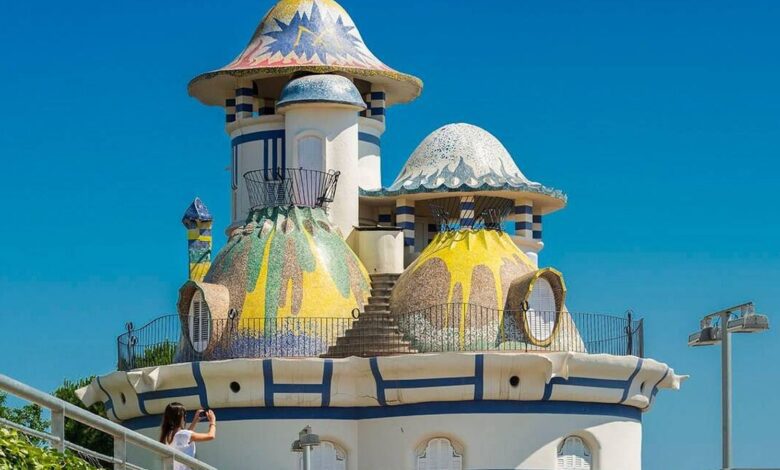
In the very heart of Catalonia, far from the typical tourist trails, stands a building that can surprise even seasoned architecture enthusiasts. Its unusual shapes and striking domes, resembling giant eggs, have become a true mystery for many residents and visitors of Barcelona. Despite its external similarity to Gaudí’s works, the author of this project is another, equally talented architect whose name remained in the shadows for a long time.
We’re talking about the famous Torre de la Creu, which locals have nicknamed the ‘house with eggs.’ This structure, built at the beginning of the 20th century, still sparks debate among experts and fans of Modernisme. Many are convinced that such a bold design could only come from Gaudí’s imagination, but the building’s history proves otherwise.
An architectural mystery
Five cylindrical volumes, seemingly arranged at random, are topped with colorful domes reminiscent of giant eggs. This combination of forms and colors is unique in Barcelona. The house was built between 1913 and 1916 as a summer retreat for the architect’s family. Despite its originality, the building remained unnoticed by Barcelonans themselves for a long time.
The exterior of Torre de la Creu is truly puzzling: organic lines, asymmetry, interplay of light and shadow—all of this evokes Gaudí’s style. But behind the project stood his student and associate, who managed to create an architectural language of his own, no less expressive than that of his famous mentor.
A Timeless Master
The house was designed by Josep Maria Jujol—a figure unfairly overlooked outside of architectural circles. Not only did he collaborate with Gaudí on projects such as the Sagrada Família and Park Güell, but he also developed his own ideas, boldly experimenting with forms and materials. With Torre de la Creu, he brought to life an architectural fantasy unfettered by any conventions.
Jujol received total creative freedom from his aunt, for whom this remarkable house was built. The result is a building with not a single standard detail: the layout, staircases, windows, and even the railings are all crafted in a unified organic style. Three main cylinders form the living space, while two smaller ones house spiral staircases leading up to viewing platforms.
Vivid Details
The main feature of the house is its domes, which were originally covered with glass mosaic and later with ceramic tiles. This element gives the building a sculptural appearance and enhances the impression that it has grown naturally from the earth. Its color palette and gentle curves make the house resemble a fantastical set piece—though it is entirely functional as a home.
The wrought ironwork is equally striking: handcrafted by artisans, it emphasizes the individuality of every detail. Jujol was not merely following the trend of modernism; he was ahead of his time, creating architecture where emotion and nature are the main sources of inspiration.
Off the Tourist Path
Today, Torre de la Creu is recognized as a national cultural heritage site, yet it remains little known to the general public. Perhaps the reason lies in its location outside central Barcelona, or maybe it’s the building’s unusual appearance, which doesn’t fit the typical image of Catalan Modernism.
For those who decide to visit Sant Joan Despí, there’s an opportunity to discover architecture that defies convention. The house is part of a dedicated route highlighting Jujol’s works and is open for small group tours. Visits require advance booking, which adds an extra allure to this little-known monument.
Josep Maria Jujol is one of the most remarkable figures of Catalan Modernism, whose works remained overshadowed by more famous peers for many years. His approach to architecture was marked by freedom, boldness, and deep respect for nature. Jujol was never afraid to experiment, combining traditional techniques with innovative ideas. Thanks to his creativity, Barcelona and its surroundings gained unique buildings that are now drawing increased attention from researchers and art enthusiasts. Torre de la Creu is a vivid example of how individuality and talent can transform an entire cityscape.