The migration of the first humans to what is now Australia turned out to be much more complex than scientists assumed just a few years ago. A major new DNA study of the region’s Indigenous peoples has made it possible to reconstruct not only when, but also how ancient seafarers reached the mysterious continent. It turns out that settlement took place along two separate routes, and the journeys themselves required remarkable courage and technical skill.
During the era when sea levels were much lower, the landscape of Southeast Asia and Oceania looked completely different. Vast areas of land were connected, separated only by deep straits and chains of islands. These bodies of water became the main challenge for the first migrants.
Ancient continents and barriers on the path to Australia
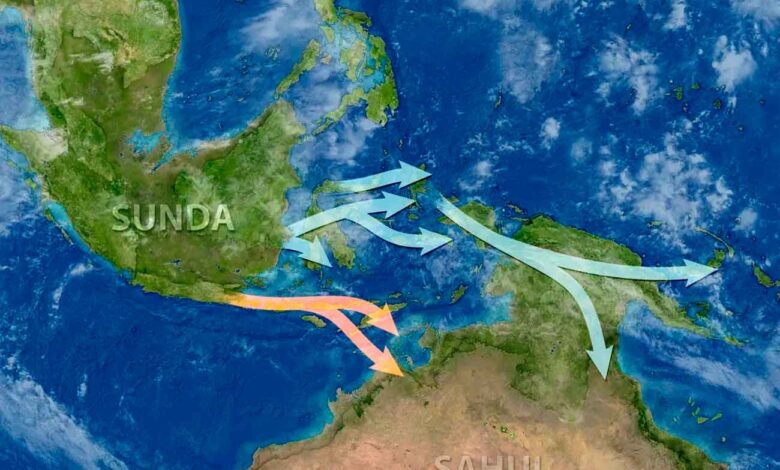
Tens of thousands of years ago, Sundaland united most of Southeast Asia, while Australia, New Guinea, and Tasmania formed a single landmass known as Sahul. Yet even at the lowest sea levels, a chain of islands known as Wallacea separated these regions. Deep straits between the islands made crossings on foot impossible, forcing people to look for alternative ways to travel.
To reach Sahul, ancient people had to cross open ocean for distances of more than 100 kilometers. Such maritime expeditions required not only courage, but also advanced shipbuilding and navigation skills. It was a true test of human capabilities for that era.
When and how Sahul was first settled
The timing of the first human arrival in Australia has long been debated. Archaeological finds at the Madjedbebe site in northern Australia suggest an age of about 65,000 years. However, genetic studies of modern populations in the region point to later dates—between 45,000 and 50,000 years ago.
The migration route was no less hotly debated. There were two main hypotheses: the “southern route” via the islands of Timor and Roti, and the “northern route” through the Philippines and Sulawesi to New Guinea. Recent archaeological finds on Sulawesi, where stone tools over a million years old were discovered, have strengthened the case for the northern direction.
Genetic analysis: two migration streams
An international team of scientists led by Martin Richards from the University of Huddersfield conducted an analysis of 2,456 mitochondrial genomes from indigenous peoples of Australia, New Guinea, as well as residents of the western Pacific and Southeast Asia. Mitochondrial DNA makes it possible to trace maternal lineages and date key events in population history.
Using the ‘molecular clock’ method, researchers determined that the split in ancestral lineages occurred about 60,000 years ago. It was at this time that the ancestors of today’s Aboriginal Australians and Papuans began their journey south, separating from other groups in the region.
The most surprising finding was confirmation that Sahul was populated simultaneously via two routes. The majority of settlers followed the northern route—through the Philippines, Sulawesi, and then into New Guinea. The southern route, passing through Timor and Rote, was used by a smaller number of migrants. Thus, ancient people did not limit themselves to a single direction, but explored multiple pathways at once.
Feedback loops and further dispersal
Geneticists found that migration was not one-way. In a burial on Sulawesi island dating back 1,700 years, an ancient New Guinean genetic lineage was identified. This suggests that contacts between the islands and the mainland persisted for thousands of years, and descendants of the first settlers returned to previously traversed territories, leaving their mark on the gene pool of local peoples.
After arriving in Sahul, the seafarers did not linger. They moved rapidly eastward, settling new lands and reaching what are now the Solomon Islands. These ancient people exhibited remarkable mobility, exploring coasts and islands—further proof of their high adaptability to life in challenging environments.
In case you didn’t know, Professor Martin Richards is one of the leading experts in population genetics and evolutionary biology. His team at the University of Huddersfield regularly publishes research on ancient migrations and the genetic history of humanity. Richards’ work is internationally recognized and often serves as the foundation for new discoveries in anthropology and archaeology.