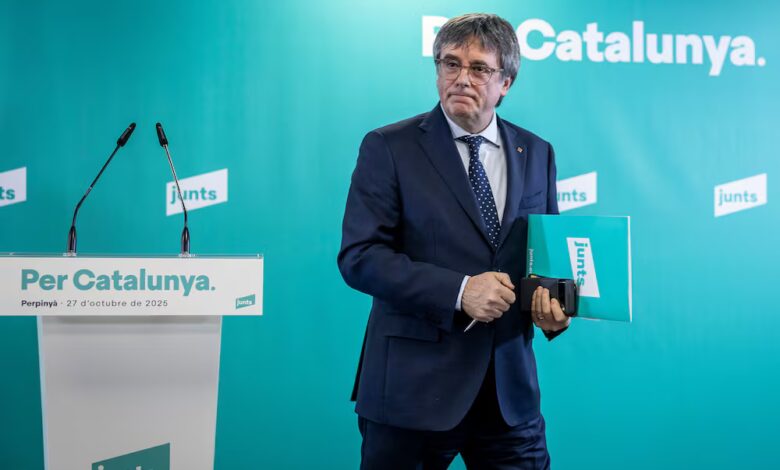
Political uncertainty is growing in Catalonia: the fate of Carles Puigdemont as leader of Junts per Catalunya has become a major stumbling block for the nationalist movement. The question of his possible resignation has been looming for some time, but discussing it openly is still considered taboo. The consequences of this silence are felt not only within the party, but across the region’s entire political scene. For Spaniards, this means the future of Catalan nationalism remains in question, and any shift could alter the country’s balance of power.
Recent polls show Puigdemont’s support among voters has declined significantly. According to the Institute of Political and Social Sciences, only 10.2% of respondents would like to see him as president of the Generalitat. In comparison, socialist leader Salvador Illa enjoys 20.9% support, while the rising figure of right-wing nationalism Silvia Orriols is already at 8.8%. Even among Junts supporters, there’s no consensus on the need for change, and Puigdemont himself is now seen as a symbol of a bygone era.
Change remains taboo
Any attempt to raise the topic of changing the leader sparks a heated reaction. Artur Mas, the former head of the Generalitat, recently hinted cautiously at the need for new leadership, citing the example of Jordi Pujol, who once voluntarily stepped down for the sake of the party’s future. However, even such delicate remarks drew a wave of criticism, and Mas had to quickly backtrack. Within Junts, Puigdemont remains an untouchable figure, despite clear signs of fatigue and frustration among the electorate.
The problem is compounded by Junts’ inability to reclaim leadership in the right-wing nationalist camp. The competition with Sílvia Orriols’ alliance is intensifying, while the traditional dominance once secured by the CiU coalition is fading into the past. The decision of Partido Popular to bet on anti-Catalan rhetoric only strengthens Junts’ standing among Catalan nationalists, but does not help expand its electoral base.
A leader without a future?
Puigdemont is still seen as a hero of the 2017 events by his supporters, even though many observers believe his actions led to a heavy political defeat. For his core followers, he remains a martyr who must keep the movement alive. However, the reality is that Junts cannot leverage its unique position in the Congress of Deputies to achieve real political gains. Puigdemont has become a kind of ‘stopgap,’ preventing the party from moving forward and learning from past mistakes.
Even cautious hints at the need for change from figures like Artur Mas are perceived as a challenge to the established order. As a result, the party finds itself trapped: on one hand, Puigdemont’s personality cult persists, and on the other, pressure from new political forces and disillusioned voters continues to grow.
Internal conflicts
Intraparty disagreements are becoming increasingly apparent. Even those who consider leadership change necessary are reluctant to discuss it openly. As a result, Junts risks losing momentum and yielding ground to more dynamic players on Catalonia’s political scene. The situation is further complicated by the fact that any change could trigger a split within the party and weaken the nationalist movement as a whole.
Recalling recent events, it is worth noting that political crises in Catalonia are not uncommon. For example, after the transport collapse and the accident on Rodalies, which we reported on earlier, the region found itself at the center of high-profile demands for resignations and mass protests. Learn more about how these events affected the political atmosphere in our story at this link.
Context and consequences
In recent years, Catalonia has repeatedly become the scene of intense political conflicts tied to leadership and internal discord within nationalist parties. These situations have already led to leadership changes and significant reshuffles in parliament. Outbreaks of discontent within parties often coincided with declining ratings and strengthened competitors, which ultimately shifted the regional balance of power. In other cases, attempts at renewal ended in splits and the formation of new political movements, further fueling instability. These processes continue to shape Catalonia’s political landscape and that of Spain as a whole, making the question of a leadership change in Junts per Catalunya especially relevant.