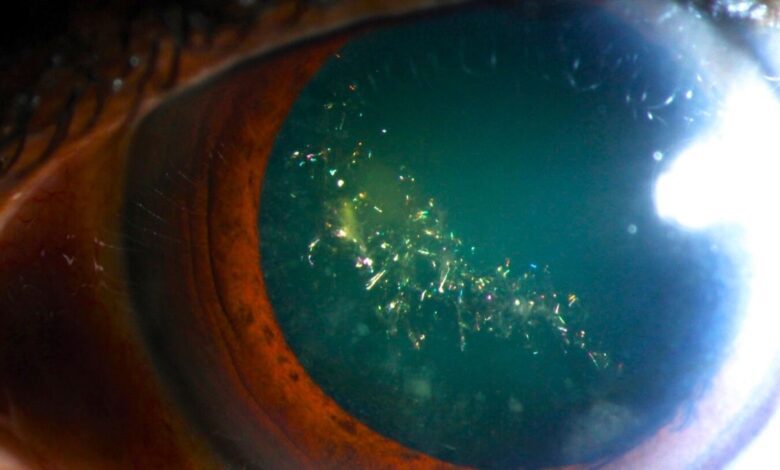
Doctors sometimes encounter an unusual phenomenon: some patients experience a remarkable twinkling in their eyes, reminiscent of the colorful lights on a Christmas tree. This is not an optical illusion or the effect of dancing light, but a manifestation of a rare age-related condition known as ‘Christmas cataract.’ This ailment is extremely uncommon, yet it never fails to astonish specialists when it appears.
Crystals begin to form inside the lens of the eye, shimmering with all the colors of the spectrum under certain lighting. When a doctor shines a light into the pupil, the view through the microscope reveals a true spectacle: pink, green, blue, golden, and red needle-like structures decorate the lens interior like festive garlands. This sight not only captivates the imagination but also helps doctors detect underlying diseases.
Causes
The main cause of this effect is calcium accumulation in the lens. This process accelerates the breakdown of proteins known as crystallins, which are responsible for the lens’s clarity and elasticity. As these proteins degrade, the amino acid cystine builds up in the tissue. When it reaches high concentrations, cystine crystallizes, forming thin, needle-shaped structures.
It is these crystals that create the characteristic ‘Christmas’ shimmer, which often surprises ophthalmologists. The colors vary depending on the angle of the light and the structure of the crystals. Sometimes a patient may not even be aware of the condition until a routine specialist examination.
Connection with other diseases
Although Christmas cataract rarely affects visual acuity, it can serve as an important diagnostic marker. Such changes are particularly common in people with myotonic dystrophy—a hereditary disease affecting muscles and other body tissues. Almost all patients with this diagnosis are found to have these distinctive lens crystals during medical examinations.
Therefore, the appearance of multicolored needles in the eye can be the first sign of more serious health issues. In some cases, this makes it possible to begin treatment at an early stage, before other symptoms emerge.
How the condition manifests
During a slit lamp examination, the doctor observes numerous fine crystals in the pupil, crossing the lens fibers in different directions. They may be scattered randomly or form intricate patterns. The color spectrum ranges from soft pinks to deep greens and golden hues.
Sometimes the crystals are so small that they can only be seen under high magnification. In other cases, they are visible to the naked eye under certain lighting conditions. Despite their striking appearance, most patients do not experience discomfort or vision loss.
Diagnosis and Monitoring
A standard ophthalmic examination is sufficient to make the diagnosis. The doctor looks for characteristic features and may order additional tests if needed. It’s important to distinguish Christmas cataract from other types of lens opacities to avoid missing any potential accompanying conditions.
Treatment is usually not necessary if vision is unaffected. However, patients with such changes are advised to undergo regular eye exams to monitor their eye health and detect possible complications early.
If you didn’t know, Saint Nicholas (Saint Nicholas) is one of the most revered Christian saints, whose image is often associated with Santa Claus. In folklore, he is credited with a kind gaze and a special sparkle in his eyes. In modern medicine, the term ‘Christmas cataract’ refers to a rare type of cataract characterized by polychromatic crystals appearing in the lens. This phenomenon not only surprises doctors but also helps detect hereditary diseases at an early stage.