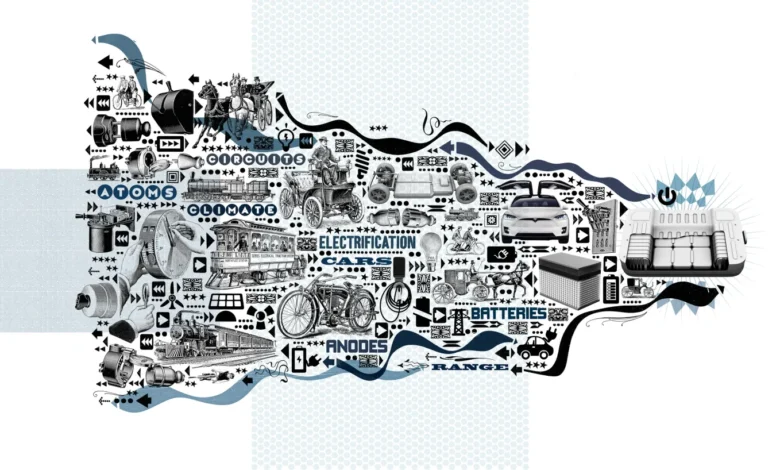
By 2026, electric cars are no longer a novelty. In the US, for example, they account for over 50% of new passenger vehicle sales. This isn’t just a statistic—it’s a revolution that can’t be ignored. Analysts estimate that meeting the soaring global demand will require building at least 90 more gigafactories, each on the scale of the Tesla plant in Nevada. And that’s just the beginning.
Inside the battery
Lithium-ion batteries are the heart of every electric car. They also power our smartphones, laptops, and even some aircraft. Lithium is a metal with unique chemical properties, allowing batteries built on its base to store huge amounts of energy at a relatively low weight. Currently, an average EV battery weighs around 450 kilograms and costs manufacturers about $15,000. That’s enough energy to power a house for several days.
Every battery contains hundreds or even thousands of cells, resembling tiny cylinders or flat pouches. Each cell has a cathode made of nickel, manganese, and cobalt oxides, a graphite anode, and a liquid electrolyte. This is where the magic happens: lithium easily releases its outer electron, turning into an ion that moves between the cathode and anode, enabling the flow of charge. During charging, electrons rush to the anode, with lithium ions following through the electrolyte. When discharging, the process reverses, delivering energy to the electric motor.
The race for raw materials
Demand for lithium, nickel, cobalt, and graphite is growing so rapidly that in recent years, lithium compound prices have soared nearly tenfold. Dozens of new factories are under construction in the United States and raw material extraction projects are underway. But this boom conceals complex challenges: most of the world’s cobalt comes from the Democratic Republic of the Congo, where cases of child and forced labor are still documented. In Chile, one of the leading lithium producers, the authorities are trying to regain control of resources from multinational corporations. And in the US, a significant share of deposits is located on Indigenous lands, fueling protests and disputes.
At the same time, a debate is intensifying over mining minerals from the ocean floor. Some companies are already planning to tap into the deep sea, despite environmental protests and calls for a moratorium. Chile, for example, advocates for a temporary ban on such projects, fearing the destruction of unique ecosystems.
Technologies of the future
Engineers and startups worldwide are seeking ways to make batteries cheaper, lighter, and more environmentally friendly. Cobalt-free lithium-ion batteries have already emerged, reducing dependency on problematic suppliers. Labs are testing sodium-sulfur cells, which are less expensive and use more readily available materials. Solid-state batteries are attracting particular interest—they replace the liquid electrolyte with a solid material. These batteries promise to be lighter, safer, and to charge much faster.
The battery market has become a battleground for real technological rivalry. Manufacturers are racing not only to cut production costs, but also to establish effective recycling of used batteries. In the coming years, we will see a few major players cement their positions in the market, while others will be forced either to merge or to exit the race.
Economy and environment
Experts are confident: in just a few years, electric cars will match gasoline vehicles in price. This will speed up the shift to electric transport and bring new challenges for energy and infrastructure. Yet behind every new battery lies more than technological progress—there are questions: how do we extract raw materials without harming nature, how do we recycle old batteries, how do we ensure fair resource allocation?
I often think that the journey lithium ions make inside a battery is more than just a physical process. It’s a symbol of change that affects millions of people, entire industries, and even international relations. Over the next decade, these invisible journeys will define the future of transport, energy, and possibly the planet itself.
In case you didn’t know, Tesla is an American company founded by Elon Musk in 2003. It has become one of the main drivers behind the development of electric vehicles and battery technologies worldwide. Tesla’s Gigafactory Nevada is one of the largest lithium-ion battery plants in the world. The company actively invests in new battery technologies and is expanding production to meet the growing global demand for electric vehicles and energy storage systems.