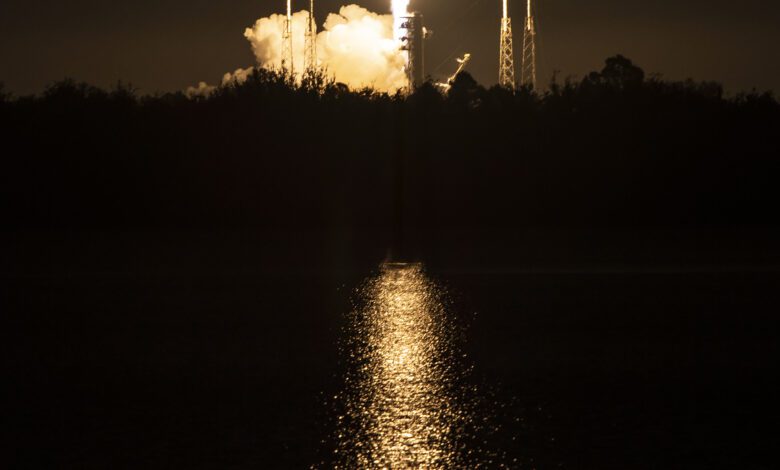
On the night of January 4, 2026, the latest Falcon 9 rocket lifted off from Cape Canaveral, carrying 29 Starlink satellites aboard. The launch occurred at 1:48 a.m. Eastern Time, when most Floridians were still asleep, but for SpaceX engineers it was a true test. Less than ten minutes after liftoff, the satellites reached low Earth orbit, and within an hour, they began forming a new segment of the global data network.
This launch marked the first Starlink mission of 2026 and the second SpaceX launch in the opening days of January. The company continues to ramp up its pace, showcasing its confidence in its technology: the Falcon 9 stage, used for the first time, achieved a soft landing on the autonomous drone ship Just Read the Instructions in the Atlantic. This signature SpaceX maneuver never fails to impress—as returning a rocket to a floating platform in the ocean demands extraordinary precision.
While some focus on the technical details, others point to the social impact. The Starlink network, which now boasts about 9,500 active satellites, is changing the rules for millions of people around the world. Venezuela has now joined that network—after recent events in Caracas put internet access at risk. SpaceX announced that Venezuelan residents will have free access to Starlink internet until February 3—a move that could be a lifeline for many families and businesses.
Technology and challenges
Each Starlink launch is more than just another batch of satellites—it’s part of an ambitious experiment to create a global internet network. SpaceX is advancing steadily toward its goal: to provide reliable connectivity even in the most remote corners of the planet. To achieve this, the company uses a unique approach—satellites are placed in low Earth orbit, reducing signal latency and increasing data transfer speeds.
However, it’s not all smooth sailing. The growing number of satellites has raised concerns among astronomers and space debris experts. Some believe the Starlink megaconstellation could hinder observations of the night sky and increase the risk of collisions in orbit. In response, SpaceX is implementing new technologies to reduce satellite reflectivity and improve maneuverability.
Meanwhile, users worldwide note that connection quality improves with each new launch. This is especially noticeable in areas where traditional providers can’t offer stable internet. For many residents of rural areas and small towns, Starlink has become a true window to the world.
Global Impact
The expansion of the Starlink network is not only a technological breakthrough, but also a significant political factor. As access to information becomes ever more crucial, the ability to bypass government restrictions and censorship is especially valuable. Venezuela’s experience shows that satellite internet can become an important tool for supporting civil society during times of crisis.
SpaceX makes no secret of its ambitions: the company plans to increase its number of satellites to 12,000, and potentially up to 42,000 in the future. This will enable coverage of virtually the entire surface of the Earth, including oceans and polar regions. Starlink is already being used not only for everyday needs, but also to support emergency services, scientific expeditions, and even military operations.
However, not all countries are ready to welcome such expansion. Some governments fear losing control over their information space and are imposing restrictions on the use of satellite internet. Nevertheless, demand for Starlink’s services continues to grow, and the company itself is becoming an increasingly influential player in the global telecommunications market.
The future in orbit
With each new launch, SpaceX further cements its status as the leader in commercial space transportation. The successful landing of a Falcon 9 first stage—the 555th to date—confirms that reusable rockets are becoming the industry standard. This not only lowers the cost of launches but also opens up new opportunities for developing space infrastructure.
Several more Starlink launches are expected in the coming months, along with missions carrying cargo for NASA and other clients. SpaceX continues to surprise the world with its innovations and bold solutions, reshaping perceptions of what is possible in modern spaceflight. The question is how quickly humanity can adapt to this new reality, where internet connectivity could soon reach virtually anywhere on the planet.
SpaceX is a private aerospace company founded by Elon Musk in 2002. The company specializes in developing and launching Falcon rockets, Dragon spacecraft, and building the Starlink global satellite network. SpaceX is renowned for its innovations in reusable rockets and its active promotion of the idea of Mars colonization. In recent years, it has become a key player in the global space services market, carrying out hundreds of successful launches and implementing several ambitious projects.