Rare earth elements have long ceased to be the domain of a handful of specialists. Today, they are a strategic resource essential for everything from electric vehicles and modern smartphones to the defense industry. As of 2025, the global distribution of these metals resembles a chessboard, where the key pieces are placed far from evenly.
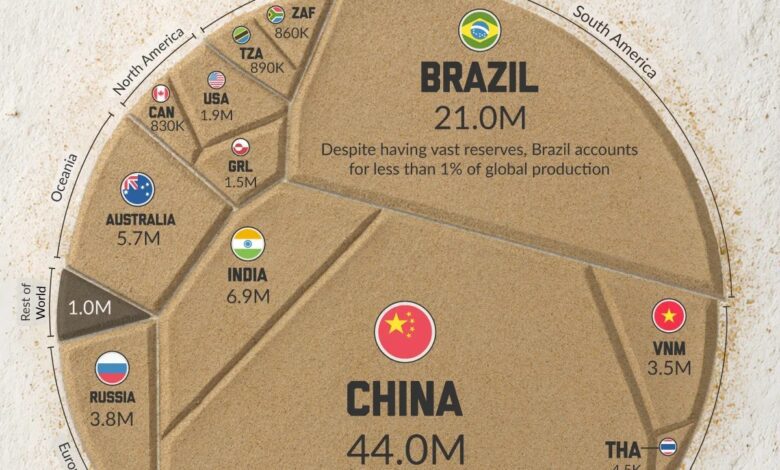
China firmly maintains its leadership, holding nearly half of the world’s known rare earth reserves—44 million tons. This number is striking, especially considering that its closest rival, Brazil, has just 21 million tons. The United States, despite being the world’s largest economy, can only count on 1.9 million tons, which is about 2% of the global total. The concentration of resources in the hands of a few countries is setting new rules on the global market.
Geography of influence
A look at the map makes one thing clear: most rare earth elements are concentrated in Asia and South America. Besides China and Brazil, significant reserves are found in India (6.9 million tons) and Australia (5.7 million tons). Russia and Vietnam are also among the leaders, even surpassing the United States in terms of resources.
Together, six countries—China, Brazil, India, Australia, Russia, and Vietnam—control about 80% of all known reserves. This creates a unique situation: the advanced economies of Europe and North America are forced to rely on imports and external supplies, leaving them vulnerable to geopolitical risks and trade restrictions.
Technology and policy
Rare earth metals are more than just raw materials for manufacturing. They form the foundation of cutting-edge technologies, from electric vehicle batteries to navigation systems and defense complexes. That’s why competition for access to these resources is becoming increasingly fierce.
In recent years, the US has been working actively to reduce its dependence on Chinese supplies. The administration is investing in the development of domestic deposits, speeding up the permitting process, and seeking partners among its allies. Australia is emerging as a key player in this new coalition, while relations with Brazil, Canada, and India remain complex and sometimes contradictory.
Economy and security
A shortage of rare earth metals could paralyze entire industries. This is why leading powers are seeking not only to ramp up their own production, but also to diversify supply chains. In October 2024, the US and China reached a temporary agreement to reduce tariffs in exchange for guarantees of stable rare earth supplies. However, experts note that such arrangements may be short-lived.
Concern is also growing in Europe: limited domestic resources are forcing EU countries to seek alternative sources and sign long-term contracts with suppliers from Asia and South America. At the same time, environmental requirements and protests from local communities are making it difficult to launch new mining projects within the European Union itself.
Global challenges
Demand for rare earth elements continues to rise, fueled by the development of green technologies and the shift to a low-carbon economy. Analysts estimate that by 2030, the need for these metals could double. This means competition for access to raw materials will only intensify, and geopolitical risks will increase.
With a handful of countries controlling the vast majority of global reserves, even minor changes in export policy or domestic regulations can cause serious market disruptions. For Spain, as for most European countries, ensuring stable supplies is becoming increasingly urgent.
If you didn’t know, China is the world’s largest producer and exporter of rare earth metals, accounting for not only nearly half of global reserves but also a significant share of processing. Brazil holds the second largest reserves, but its share of global exports remains small. The United States is actively investing in developing its own mining industry but still relies on imports. Australia and India are also ramping up production, aiming to secure a more prominent role in the global market. In recent years, attention to these countries has only grown, as the stability of global technology supply chains depends on their policies.