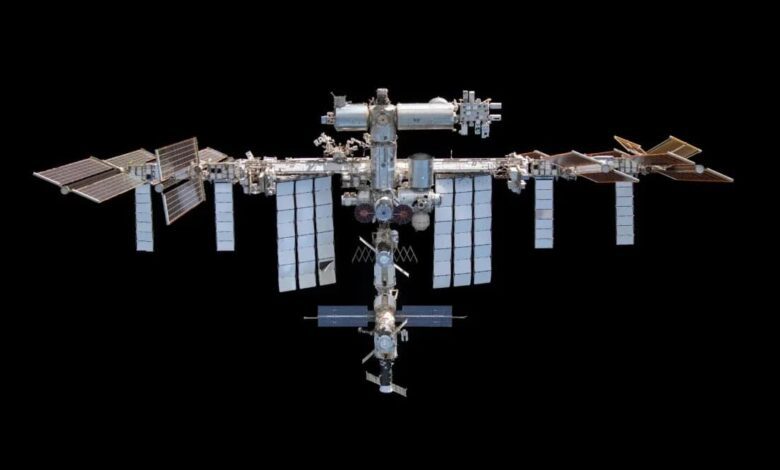
The International Space Station (ISS) is experiencing a unique moment: for the first time in its history, eight different spacecraft are docked at the station simultaneously. This milestone was achieved thanks to the coordinated work of specialists and precise planning; to accommodate new crews and cargo, one of the modules had to be temporarily relocated. Last week, the flight control team in Houston used the Canadarm2 robotic arm to carefully move the Cygnus cargo spacecraft, freeing up a docking port for the arrival of the crewed Soyuz MS-28.
On board the new Soyuz were NASA astronaut Chris Williams, along with Roscosmos cosmonauts Sergey Kud-Sverchkov and Sergey Mikaev. Their arrival at the station was part of a complex logistical operation, as there were almost no docking ports available. Every maneuver requires precision and coordination between international teams to avoid even the slightest disruption to station operations.
While the new crew was arriving, another Russian crewed spacecraft — Soyuz MS-27 — was already docked with the ISS. This spacecraft, attached to the Prichal module, is completing its mission: its return to Earth is scheduled for December 8. NASA astronaut Jonny Kim and cosmonauts Sergey Ryzhikov and Alexei Zubritsky will be heading home aboard it. After Soyuz MS-27 undocks, the number of docked spacecraft at the station will decrease, but for now the ISS remains the busiest spaceport on the planet.
Cargo missions
In addition to crewed spacecraft, cargo modules are also docked to the station. The Russian Progress M-92 and Progress M-93 vehicles deliver fuel, water, equipment, and food supplies for the crew. These ships are docked to the Poisk and Zvezda modules, respectively. Their regular missions sustain the station’s operations and enable uninterrupted scientific research.
The Japanese cargo spacecraft HTV-X1, docked to the Harmony module, has become another key player in this space traffic. Its mission is to deliver new scientific instruments and supplies for long-term research. The HTV-X1 features increased payload capacity and advanced control systems, making it indispensable for international projects aboard the ISS.
The two Dragon capsules from SpaceX occupy a special role. These vehicles not only deliver cargo, but can also serve as crew evacuation vehicles in case of emergencies. Dragon has proven to be a reliable and versatile spacecraft, capable of handling a variety of tasks in orbit.
Orbital logistics
Coordinating the movement of spacecraft around the ISS requires the utmost precision. Every docking maneuver is agreed upon between mission control centers in different countries. For the temporary relocation of Cygnus, specialists used the Canadarm2 robotic arm, allowing them to avoid overloading the docking ports and ensuring the safety of all mission participants.
With limited space on the station, the crew must carefully plan their movements between modules. Every new spacecraft brings not just supplies, but additional tasks such as unloading, maintenance, and preparations for the return flight. At such times, the ISS resembles a bustling train station, where the schedule is mapped out to the minute.
Operations become more complicated when crews from different countries are aboard the station at the same time. The language of communication, safety standards, and technical protocols—all of this requires constant collaboration and mutual understanding between cosmonauts and astronauts. Thanks to this, the ISS remains a model of successful international cooperation in space.
The Future of the Station
The current record for the number of docked spacecraft highlights the ISS’s growing role as a hub for scientific and commercial missions. In the coming years, the number of launches is expected to rise, including those involving private companies and new international partners. This opens up additional opportunities for research and for developing technologies necessary for deep space exploration.
Continuous crew rotations and regular cargo shipments keep the station running smoothly. Every new spacecraft contributes to the common goal, whether delivering equipment, conducting experiments, or returning results to Earth. The ISS remains a unique platform for testing and scientific breakthroughs, bringing together scientists and engineers from around the globe.
In case you didn’t know, the ISS (International Space Station) is the largest collaborative project in the history of space exploration, involving NASA, Roscosmos, the European Space Agency (ESA), the Japan Aerospace Exploration Agency (JAXA), and the Canadian Space Agency (CSA). The station was launched into orbit in 1998 and has since served as a laboratory for unique experiments in microgravity. Over the years, the ISS has hosted dozens of crews and hundreds of cargo missions, becoming a symbol of international cooperation and scientific progress.