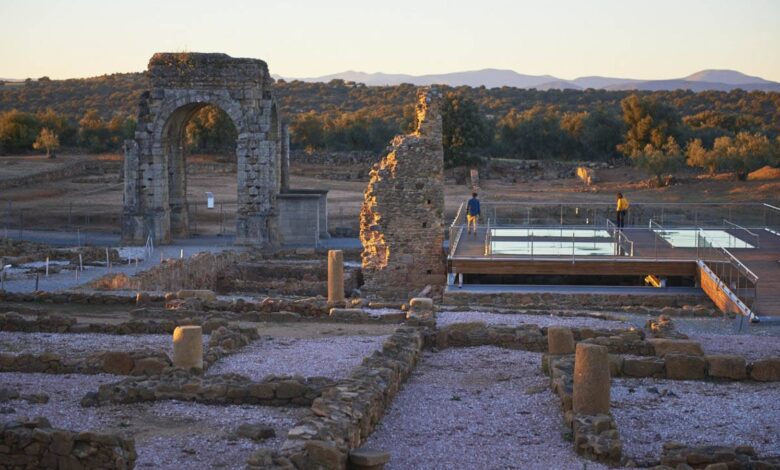
In the lands of Extremadura, far from bustling tourist routes, true historical treasures are hidden. One such place lies in the north of the province of Cáceres, where time seems to have stood still, inviting everyone to touch the legacy of a great civilization. Here, amid picturesque landscapes, stretch the ruins of an ancient settlement that was once an important center on the famous ‘Silver Route’ (Vía de la Plata), which connected the south and north of the Iberian Peninsula.
This is the archaeological complex of Caparra, a city that reached its peak in the 1st century AD when it was granted municipal status. Its strategic location on the route between Emerita Augusta (modern Mérida) and Asturica Augusta (Astorga) ensured its prosperity and influence. Today, walking its ancient streets allows visitors to imagine the vibrant life that flourished here nearly two millennia ago. You can still see remnants of paved roads, the foundations of houses and public buildings—all bearing witness to the former grandeur of this site.
The main jewel of Caparra and its undeniable symbol is the tetrapylon—an impressive four-sided arch unlike anything else in Spain. Built during the Flavian dynasty, this monument stands at the intersection of the city’s two main arteries—the cardo and the decumanus. The structure rests on four massive pylons and is adorned with a striking archivolt. It is believed that the construction was initiated by the local aristocrat Marcus Fidius Macer, whose name is preserved on stone slabs. The arch was not just an ornament; it served as the center of urban life and a symbol of prestige.
Exploring the complex goes far beyond the famous monument itself. The site is well-equipped for visitors. Here, you can see the ruins of the baths, amphitheater, and residential quarters that once housed shops and workshops. The entire route is lined with information boards to help you navigate and understand the purpose of various structures. Best of all, access to this unique open-air museum is completely free for everyone.
For a deeper insight into history, an Interpretation Center operates next to the excavations. Inside, visitors will find detailed models recreating the appearance of the ancient city, information panels, and audiovisual materials that bring the past to life. The complex, located near the modern A-66 highway, offers convenient parking and a rest area. In recent years, it has also become one of the venues for the renowned International Classical Theater Festival in Mérida, highlighting its enduring cultural significance.