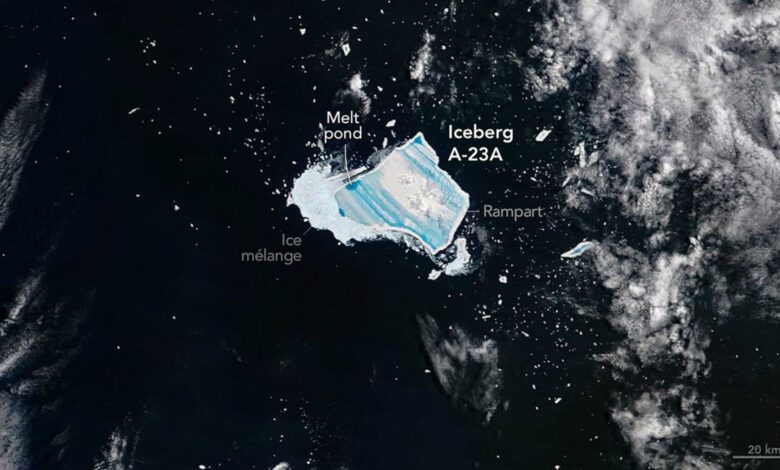
A true drama is unfolding in the South Atlantic: a giant iceberg that has roamed the ocean for over forty years is now rapidly losing its icy mass. Its once dazzling white surface is now streaked with aquamarine lines and patches—these are meltwater lakes formed under the scorching summer sun. Satellite images are striking: the ice colossus appears to glow from within, surrounded by a chaotic crown of detached ice fragments. Scientists, who have monitored this iceberg since the late 1980s, admit that we may be witnessing its final act.
This frozen giant, named A-23A, broke away from the Filchner Ice Shelf in 1986—the same year marked by the disasters at the Chernobyl Nuclear Power Plant and the space shuttle Challenger. Since then, the iceberg has become something of a celebrity among scientists: its enormous size and remarkable longevity have kept it under close observation. Over the decades, it has drifted from the Antarctic coast to waters between South America and South Georgia Island, where it now floats, slowly dissolving into the ocean.
Icy stripes
The latest satellite images show distinct blue streaks—these are meltwater lakes that form on the surface when temperatures rise and the sun grows especially intense in the southern hemisphere. On December 26, 2025, the Terra satellite captured these changes, and just a day later, an astronaut aboard the International Space Station took a detailed photo using a professional camera. Such images reveal how water gathers in depressions, gradually weakening the ice structure.
The scale of what’s happening is striking: iceberg A-23A is one of the largest and longest-lived in recorded history. Its fate is more than just a scientific curiosity. When meltwater lakes appear on the surface, their weight and pressure can literally fracture the ice shelf from within. Water seeps into cracks, widens them, and at some point, the iceberg may split into numerous pieces. This is how the most dramatic breakups of ice shelves and icebergs occur.
Impact on the ocean
But the disappearance of such a giant is more than a spectacle for scientists and nature enthusiasts. When an iceberg of this size melts, it releases a massive amount of cold, fresh water into the ocean. This can alter local currents, mix layers, and even bring nutrient-rich deep waters up to the surface. Such processes fuel the growth of phytoplankton—microscopic algae that form the foundation of the entire marine food web.
In recent years, such phenomena have become increasingly common. Climate change and global warming are accelerating the melting of glaciers and icebergs, making these events not the exception, but the new norm. For scientists, this is a unique opportunity to observe how these icy giants break apart in real time and to improve the models that help predict the future of the planet’s ice sheets.
Global consequences
The fate of A-23A is more than just the story of a single iceberg. It’s a vivid illustration of how rapidly the climate is changing and how these changes are affecting even the most remote corners of the Earth. Every time an iceberg like this disappears, it leaves behind not only a mark in the ocean but also new scientific questions. How will water circulation change? How will the marine ecosystem respond? And how many more of these giants are drifting, awaiting their turn?
We may be witnessing the final days of one of the world’s most famous ice giants. Its blue streaks are not just a beautiful effect, but a stark warning that the processes of destruction are accelerating. And while icebergs have always been part of the natural cycle of glacier renewal, today their disappearance is taking on new scale and significance.
RUSSPAIN notes that iceberg A-23A is one of the largest tabular icebergs ever recorded. Over the years, its area has exceeded 3,800 square kilometers, comparable to the size of some major European cities. Leading scientific centers around the world are monitoring its movement and condition, and its fate has become a symbol of the changes taking place in Antarctica and the world’s oceans.