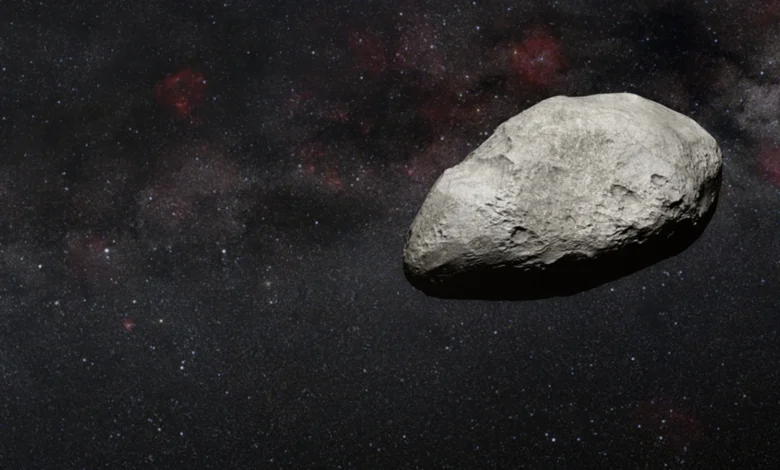
At the start of 2026, millions of people around the world will be looking to the sky. The reason is an unusually large asteroid, designated 2005 UK1, which will pass at a relatively close distance to our planet. Despite alarming headlines and talk of a potential threat, experts assure: there is no real danger to Earth. Nevertheless, the event is capturing keen interest not only from astronomers, but also from the general public.
This cosmic visitor, whose diameter is estimated between 600 meters and 1.4 kilometers, was first discovered in Arizona back in 2005. Since then, its trajectory has been closely monitored, and every new approach to Earth sparks discussions and scientific research. This time, the asteroid will pass at a distance of about 12 million kilometers—more than 30 times farther than the Moon.
Category: ‘Potentially Hazardous’
So why is there so much buzz around 2005 UK1? The reason is that it has been officially included in the list of so-called ‘potentially hazardous’ objects. This requires two conditions: a size greater than 140 meters and the possibility of approaching Earth within 7.5 million kilometers in the future. However, in reality, most such asteroids pose no threat—and 2005 UK1 is a striking example.
The word “hazardous” in this context is more of a technical label than a real warning. Astronomers use it to classify and continuously track celestial bodies that could, at some point, approach our planet. In practice, however, the likelihood of this asteroid colliding with Earth in the foreseeable future is close to zero.
Observation history
Interestingly, 2005 UK1 is no stranger to the spotlight. In 2018, it also passed relatively close to Earth, and its next noticeable approach is expected in 2029, albeit at a greater distance. Each such flyby gives scientists an opportunity to gather new data about the composition, structure, and behavior of similar objects.
Modern tracking systems make it possible to detect even minor changes in asteroid trajectories ahead of time. This means any potential threat is identified long before a possible approach, giving humanity time to analyze the situation and, if necessary, take action.
Asteroids: cosmic wanderers
What exactly are these mysterious objects? Asteroids are the leftover building materials from which the Solar System was formed. Most are concentrated in the belt between Mars and Jupiter, but some, like 2005 UK1, cross Earth’s orbit, attracting both scientific interest and concern.
Although asteroids are much smaller than planets, their mass and speed make them potentially dangerous in the event of a collision. However, such incidents are extremely rare, and modern technology allows us to keep the situation under control.
Scientific significance
Every flyby of a large asteroid is not only a topic of discussion, but also a unique opportunity for science. Astronomers use these moments to study the physical characteristics of these objects, their composition, and their movement dynamics. This helps us better understand the processes that occurred in the early Solar System and increases safety for Earth.
In Spain, as around the world, such events generate keen interest. The topic is hotly debated in scientific circles and among astronomy enthusiasts, and telescopes are pointed skyward. After all, each such asteroid is not only a potential threat, but also a window into our planet’s past.
RUSSPAIN reminds readers that the asteroid 2005 UK1 was discovered as part of the international Catalina Sky Survey program, which searches for and tracks near-Earth objects. This initiative brings together scientists from different countries to quickly identify potential threats and expand our knowledge of space. Thanks to such projects, humanity can feel safer and gain unique scientific insights into the origin and evolution of the Solar System.