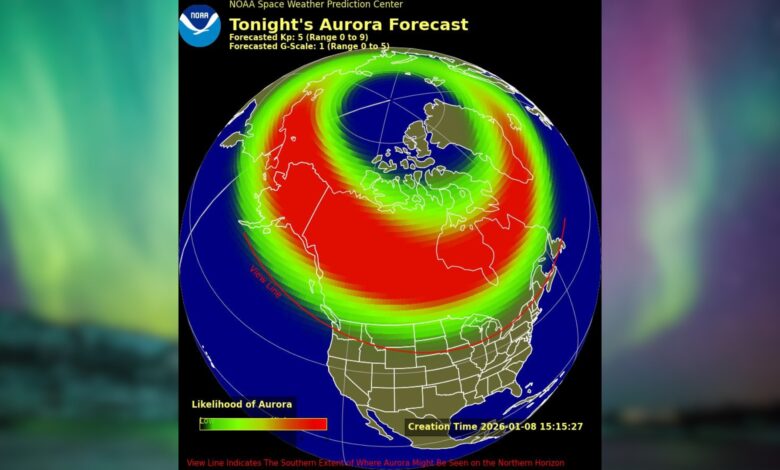
On the night of January 8 to 9, residents of the northern regions of the United States will have a rare opportunity to witness the northern lights. According to space weather experts, an unusually fast stream of solar wind, traveling at up to 700 kilometers per second, will collide with Earth’s magnetosphere. This speed is twice the usual rate and may result not only in bright flashes in the sky but also in minor geomagnetic storms.
In addition, several coronal mass ejections—known as CMEs—are heading toward our planet. If even one of them hits Earth, the chances of seeing the aurora will increase. All these factors combine to create ideal conditions for colorful ribbons and waves to appear in the night sky, which are usually only visible at higher latitudes.
Where you can catch the spectacle
According to the latest forecast maps, 12 states are either wholly or partially within the zone of visibility: Alaska, North Dakota, Minnesota, Maine, Wisconsin, Michigan, South Dakota, Idaho, New Hampshire, Vermont, Washington, and New York. However, nature does not always follow a strict schedule—sometimes the aurora can appear farther south, or may not show up at all despite all predictions.
Residents of these regions should be alert: the flashes may start after midnight and continue all the way until sunrise. The best chances are between 1 a.m. and 7 a.m. Eastern time. The essential conditions are clear skies and minimal city lights—urban glow can drown out even the brightest auroras.
How not to miss it
To make sure you don’t miss the moment, it’s best to choose a spot in advance with an open view to the north, away from streetlights and highways. Experienced aurora hunters recommend letting your eyes adjust to the darkness—just 30 minutes without bright screens or white light is enough. Modern smartphones can actually capture faint auroras before the human eye notices them, so make sure to use your camera.
Warm clothing is a must—January nights in the northern states are unforgiving. If the forecast calls for auroras, be patient; sometimes it takes several hours for the first ribbons to appear. But those who wait will be rewarded with unforgettable memories and possibly the best photos of their lives.
Technology and tips
For those who don’t want to rely solely on luck, there are dedicated apps for tracking aurora activity. Among the most popular are My Aurora Forecast & Alerts and Space Weather Live, both available for iOS and Android. These can help you not only check the chance of an aurora in your area, but also send timely notifications when activity begins.
Astrophotography enthusiasts should study northern lights shooting guides ahead of time. The main advice: use a tripod, set a long exposure, and don’t be afraid to experiment with settings. Even if the sky proves tricky, waiting under the stars will bring plenty of excitement in itself.
Why it matters
The Northern Lights are more than just a beautiful phenomenon. They serve as a vivid reminder of the close connection between solar activity and life on Earth. Geomagnetic storms can affect satellites, radio communications, and even power grids. But for most people, this night is a rare chance to witness the magic of nature firsthand, without traveling thousands of kilometers.
At moments like this, even the most skeptical city dwellers step outside to become part of a cosmic spectacle, if only for a few minutes. And though the aurora doesn’t always appear on schedule, the anticipation and hope for a miracle unite people more powerfully than any forecast.
RUSSPAIN reminds readers that the Northern Lights (Aurora Borealis) are the result of solar wind interacting with Earth’s magnetic field. This phenomenon is most commonly seen in polar regions, but during strong solar flares, it can be visible much farther south. In recent years, thanks to technological advancements and mobile apps, more people than ever have the chance to witness this unique natural show.