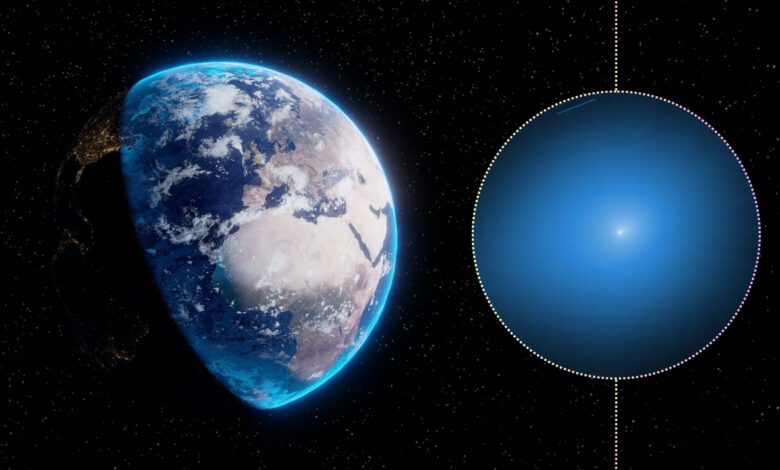
In December 2025, the astronomical community and space enthusiasts worldwide are holding their breath: the interstellar comet 3I/ATLAS is approaching Earth. This unique object, discovered just six months ago using the ATLAS telescope in Chile, has already become a true sensation among experts and enthusiasts alike. In the coming days, the comet will reach its closest distance to our planet—about 270 million kilometers—before leaving the Solar System forever.
For the first time in many years, scientists have the opportunity to observe an interstellar traveler at such close range. Objects like this rarely cross Earth’s orbit, and every such visit becomes a global event. 3I/ATLAS has already sparked numerous debates and hypotheses: from discussions about its origin to bold speculations about a possible artificial nature.
Over the next two days, astronomers will closely monitor every detail of the comet’s flyby to study its composition, structure, and trajectory as thoroughly as possible. For many researchers, this is a chance to gather new data about interstellar objects and their role in the formation of planetary systems.
The discovery story
Comet 3I/ATLAS was discovered on July 1, 2025, by the automated ATLAS system (Asteroid Terrestrial-impact Last Alert System) located in Chile. Immediately after the object was registered, specialists noticed its unusual trajectory, unlike anything seen in the Solar System. It quickly became clear: this was an interstellar visitor from deep space.
Such discoveries are extremely rare. Before 3I/ATLAS, humanity had witnessed only two interstellar comets: the famous 1I/‘Oumuamua and 2I/Borisov. Each of these objects opens new horizons for science, offering a glimpse beyond our familiar cosmic ‘home.’
Scientific significance
Observing 3I/ATLAS is not only a spectacular event for the general public but also an essential scientific experiment. Astronomers plan to use both ground-based and space telescopes to gather as much information as possible. Special attention is given to the comet’s chemical composition, which may differ from that of familiar terrestrial and solar system analogues.
Studying interstellar objects helps us understand processes occurring in other star systems. It is possible that comets like these once delivered water and organic compounds necessary for life to emerge on Earth. 3I/ATLAS presents another opportunity to put these hypotheses to the test.
What observers will see
Although the comet will not approach Earth closely enough to be seen with the naked eye, amateur astronomers will be able to observe it using powerful telescopes. For several days, 3I/ATLAS will traverse the night sky, leaving behind a characteristic tail of gas and dust. For many, this will be a true celebration of science and technology.
Professional observatories have already prepared observation schedules and are inviting everyone to join online broadcasts. The collected data is expected to help refine the comet’s trajectory and its physical characteristics.
The Future of the Comet
After its close approach to Earth, 3I/ATLAS will continue on its journey, leaving the Solar System for good. According to experts, it will never return to our cosmic neighborhood. This makes the current event truly unique—there won’t be a second chance to see this object.
Astronomers emphasize that such encounters with interstellar objects are a rare opportunity for science. Every new object brings unexpected discoveries and prompts scientists to reconsider established ideas about the structure of the Universe.
If you didn’t know, ATLAS is an international project for the early detection of asteroids and other celestial bodies that could pose a threat to Earth. The system has been operating since 2017 and has already helped identify many potentially dangerous objects. The discovery of comet 3I/ATLAS became one of the project’s most significant achievements, confirming its important role in modern astronomy.