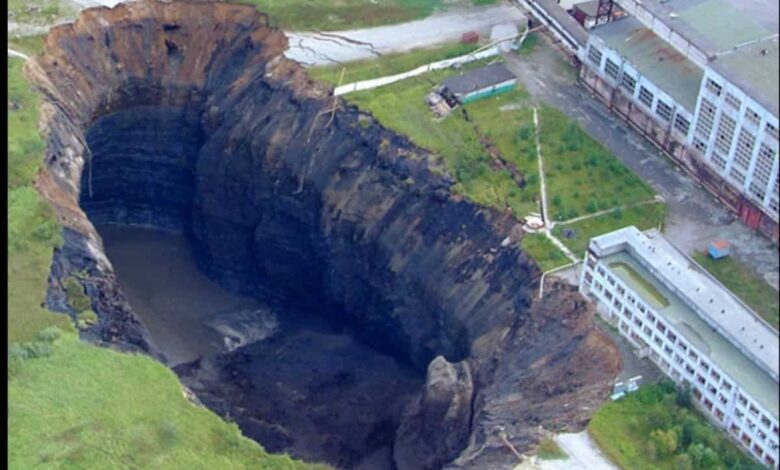
In 2025, Russian geologists reported a significant increase in potash reserves—new deposits boosted volumes by three billion tons. Potassium is in demand not only in agriculture but also in the food, pharmaceutical, and metallurgical industries, as well as in glass and detergent production. However, extracting this raw material comes with constant risks: mines are vulnerable to underground water breakthroughs, which can lead to large-scale accidents and environmental disasters.
History knows many tragic examples: the flooding of Canada’s Table Rock mine in 1975, the accident at Germany’s Neustassfurt mine in 1986, and the disaster in Berezniki in 2006. All these incidents resulted in huge losses and long-term environmental consequences. The problem of potash mine flooding remains a global issue, not just a concern for individual companies.
The dangers of potash mines
Potash deposits are geologically complex: salt layers alternate with aquifers, separated by dense rocks. When this natural barrier is disrupted—whether by tectonic activity or mining operations—it creates pathways for water. Salt dissolves rapidly, forming brine that fills voids, widens cracks, and creates new underground cavities.
Pillars—blocks of salt left to support the roof—pose a particular threat. If they collapse, water can rush in like an avalanche, causing cave-ins and sinkholes at the surface. Water entering the mine not only endangers lives and equipment, but can also trigger the release of hazardous gases.
Traditional methods
Various technologies are used to prevent flooding. Injecting special solutions into the rock creates a barrier, but this requires lengthy preparation. Automatic gates activate instantly, but their installation is very expensive and only possible in advance. The most common protective measure remains waterproof bulkheads—complex structures embedded in the rock to block the passage of water and gases.
However, installing such bulkheads is no easy task. Existing equipment, such as heavy tunneling machines, is ill-suited for confined mine spaces. Suspended rigs with hydraulic hammers can’t effectively process the upper section of the tunnel, and their operation leads to cracking, undermining the bulkhead’s future watertightness. As a result, manual refinement of the surface is needed, which increases time and costs.
A new development
Engineers from PNIPU and JSC ‘VNII Galurgii’ in Perm have proposed a fundamentally different approach. Their mobile unit features a unique mounting system: instead of being suspended from the roof, it is fixed between the tunnel walls using radial hydraulic struts. These struts extend outward from the center, creating a rigid bracing frame that securely holds the device in place.
Instead of a hydraulic hammer, the unit is equipped with a cutting crown mounted on a manipulator. It moves in a spiral, simultaneously rotating around its axis and moving along it. This method allows for the creation of niches of complex shapes with perfectly smooth surfaces, free of cracks and chips. This eliminates the need for subsequent manual finishing and speeds up the installation of bulkheads.
Advantages of the unit
An important component of the system is the pneumatic loading system—a powerful industrial vacuum that quickly removes fragmented rock from the work area. As a result, the process becomes almost continuous, and downtime for cleanup is minimized. Its mobility and easy setup make it possible to quickly deploy operations anywhere in the mine.
Using the new unit significantly reduces the construction time for waterproof bulkheads and improves their reliability. Smooth surfaces ensure watertightness, and the lack of manual labor reduces risks for workers. This leads to increased productivity and safer mining operations.
Impact on the industry
The implementation of this innovative system could change the approach to managing emergencies in potash mines. Rapid and high-quality isolation of affected areas minimizes damage, preserves infrastructure, and ensures personnel safety. The new technology has already attracted the interest of mining industry experts and could be applied not only in Russia, but also internationally.
In case you didn’t know, PNIPU (Perm National Research Polytechnic University) and JSC “VNII Galurgii” are Russia’s leading research centers in mining and the chemical industry. Their developments have been implemented at major enterprises across the country and abroad on numerous occasions. In recent years, these institutes have actively collaborated with industrial companies, developing solutions to improve both the safety and efficiency of mineral extraction.