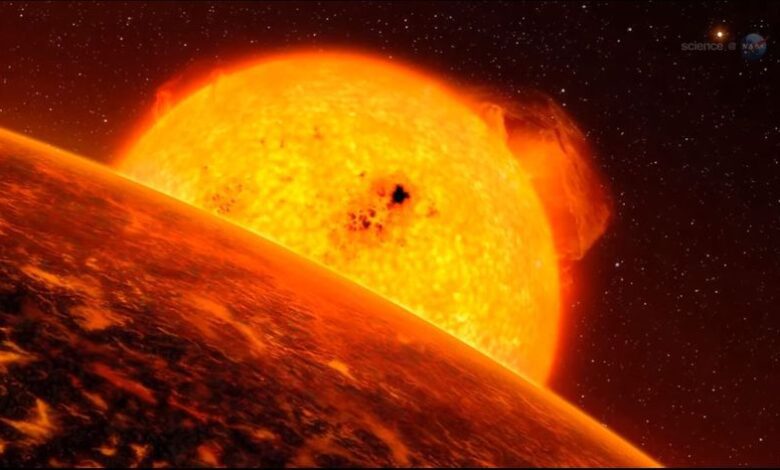
The Sun is currently about halfway through its life cycle, which means Earth is also at the midpoint of its existence. When a star exhausts its supply of hydrogen for nuclear fusion, it rapidly expands, growing hundreds of times in size. At this stage, any planets that are too close become doomed—the expanding star simply engulfs them. In our Solar System, this apocalypse won’t occur for at least another 5 billion years, but scientists are already observing similar processes unfolding in other parts of the Universe.
Using data from the TESS (Transiting Exoplanet Survey Satellite) space telescope, researchers Edward Bryant from the University of Warwick and Vincent Van Eylen from University College London compared systems with young stars to those already in the final stages of evolution. They studied both the stars themselves and whether they had planets. It turned out that as stars age, the number of planets, especially those in close orbits, drops noticeably.
“Planets disappear as their stars age,” notes Bryant. This isn’t because the planets weren’t formed in the first place; the chemical composition and mass of the stars in both groups are almost identical. The difference is that older stars become “hungry” and start consuming their companions.
The Death of Planets
Absorption is not the only way stars can destroy their planets. As a star grows, tidal forces intensify, accelerating the fall of planets onto the star, stripping their atmospheres, and potentially tearing the planets apart completely. It is this process—known as orbital decay—that underpins the model Bryant and Van Eylen used to analyze planetary demise.
Astronomers studied nearly half a million late-stage stars and found just 130 planets and planet candidates with short orbits among them. The proportion of stars with such planets drops sharply compared to younger systems, which fully supports the theory of the destructive influence of tidal forces.
To search for exoplanets with TESS, scientists track slight dips in a star’s brightness when a planet passes in front of it—a phenomenon known as a transit. This method works best for large planets similar to Jupiter that orbit close to their star. As a result, most of the detected systems are unlike our own Solar System.
Search challenges
Studying planets around older stars presents additional challenges. The larger the star, the smaller the relative size of the transit, making the signal weaker and harder to detect. However, the mass of these stars is often comparable to that of the Sun—which is the key factor determining the course of their evolution and eventual fate.
Astronomer Sabine Reffert from Heidelberg University emphasizes that this is the first time it has been statistically proven that older stars indeed have fewer planets. Previously, there simply wasn’t enough data. Now, it is clear how closely the fates of planets and their stars are connected.
The effect of metallicity
Another challenge is the age of the stars. Many of them formed long before the Sun and contain fewer heavy elements—a property astronomers call low metallicity. It is known that the higher the metallicity, the greater the likelihood of planet formation. Even a small difference in this parameter can double the number of planets in a system.
In the future, scientists plan to use spectroscopy for more precise measurements of metallicity, as well as the masses of stars and planets. This will help refine models and make predictions even more accurate. Additional data are expected after the launch of the European Space Agency’s Plato mission, scheduled for December 2026.
The future of Earth
While Earth’s demise is a matter of the distant future, these new discoveries are already providing fresh insight into the evolution of planetary systems. With each observation, astronomers move closer to understanding exactly how stars destroy their planets. In the coming years, scientists may be able to detect the slightest changes in orbits that signal the inevitable death of a world—a tragic fate for the planet, but an important step for science.
In case you didn’t know, TESS is a NASA orbital observatory launched in 2018 to search for exoplanets using the transit method. Over the years, the spacecraft has helped discover thousands of new worlds beyond our Solar System. The Plato mission, currently being prepared by the European Space Agency, is expected to significantly expand the search and analysis of exoplanets, providing astronomers with even more precise data on the structure and evolution of planetary systems.