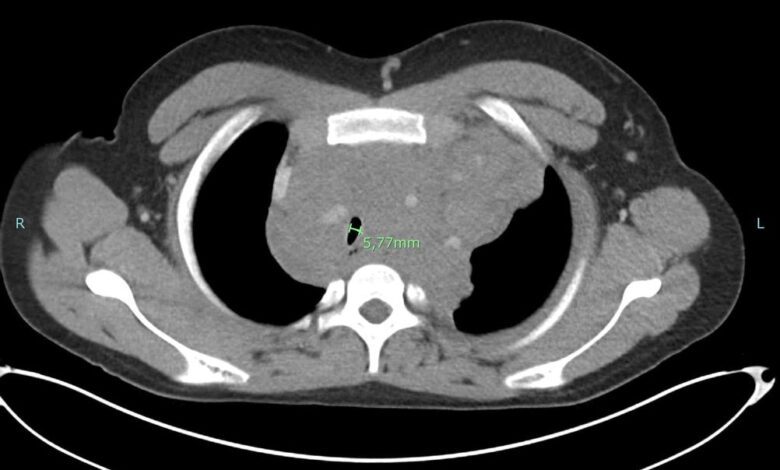
At a Canadian clinic, doctors faced a difficult challenge: a teenager needed a biopsy of a large mass in the anterior mediastinum, but standard anesthesia methods could have led to fatal consequences. General anesthesia in such cases is risky due to the chance of acute airway obstruction—the tumor was compressing the trachea and major blood vessels, and loss of muscle tone could have worsened the situation. The medical team decided to use an uncommon combination: local anesthesia and clinical hypnosis to minimize the life-threatening risks to the patient.
The teenager was admitted with complaints of a dry cough and a feeling of pressure in the chest, symptoms that were only partially relieved by inhalers. Over six months, he had lost two kilograms of weight. X-rays and CT scans revealed a massive growth encasing the superior vena cava, the left jugular and brachiocephalic veins, and narrowing the airways—the trachea measured just 5.8 mm in diameter at its narrowest point. Doctors suspected lymphoma and concluded that a biopsy was essential.
However, standard sedation and intubation were ruled out: even a minor error could have caused airway collapse. The team, led by Françoise Yung from Université de Montréal, proposed an alternative—hypnosis, performed by an experienced pediatric anesthesiologist with additional training in working with children under trance.
The hypnosis method
The patient was placed on his back with his head elevated to ease breathing. An anesthesiologist stayed nearby, maintained eye contact, and held the teenager’s hand, helping him focus and feel safe. The doctor suggested picking an object within sight and staring at it, gradually inducing a state of deep relaxation.
Once the teenager was ready, he was asked to close his eyes and imagine himself in his favorite place — his own bedroom. At that moment, the surgeons began preparing the surgical site. The anesthesiologist used verbal techniques to deepen the trance, guiding the patient to mentally join his friends on the soccer field. Throughout the procedure, the biopsy was performed under local anesthesia, and the teenager experienced no significant discomfort.
According to the patient, he could hear what was happening around him, but his attention was completely absorbed by the imaginary game. This approach helped prevent panic and pain, as well as reduce the risk of complications associated with general anesthesia.
Second attempt
The first tissue sample was uninformative — only necrotic tissue was found in the specimens. Doctors decided to perform another biopsy, this time surgically, again using a combination of local anesthesia and hypnosis. Two days later, the patient had his right supraclavicular lymph node removed following the same protocol.
Histological examination confirmed the diagnosis — Hodgkin’s lymphoma. After just the first round of chemotherapy, the teenager showed positive progress. Doctors noted that the patient remained calm and felt actively involved in his treatment, despite the complexity and potential risks of the procedures.
Hypnosis in Medicine
The use of hypnosis in clinical practice is not new, but such cases remain rare. Hypnosis is recognized as a scientifically proven non-drug method that can significantly improve patient comfort and reduce the need for sedatives. This is especially important for children and adolescents, who face higher risks of complications with general anesthesia.
Physicians emphasize that hypnosis requires specialized training and experience, as well as close cooperation between the anesthesiologist and the patient. This approach can serve as an alternative in cases where standard pain management methods carry significant risks.
The Future of Pain Management
In recent years, interest in non-pharmacological pain relief methods has grown. In addition to hypnosis, clinics are beginning to use virtual reality, which allows patients to distract themselves from discomfort during procedures. These technologies are opening up new possibilities for medicine, especially in pediatrics and oncology.
The case in Canada offered further evidence that an individualized approach and innovative methods can save a patient’s life and health where traditional solutions prove powerless. Doctors continue to seek a balance between effectiveness and safety, introducing new tools and techniques into medical practice.
If you didn’t know, Françoise Jung is a renowned specialist in anesthesiology and pediatric medicine, working at Université de Montréal. Her team is implementing modern pain management techniques and actively researching the potential of hypnosis in clinical practice. Université de Montréal is considered one of Canada’s leading medical centers, regularly pioneering innovative approaches for treating complex cases in children and adolescents.