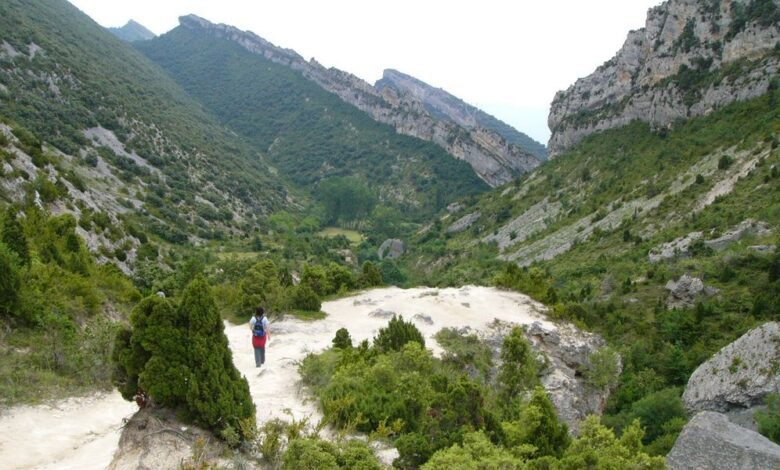
In the far west of the Basque Country, where the land of Álava meets the province of Burgos, lies the Valderejo Natural Park. Here, nature has preserved its pristine, almost wild appearance, offering solitude and genuine discoveries. While many travelers head to the lively coasts of Andalusia and Catalonia or explore cultural centers like Madrid and Barcelona, true treasures are hidden here, far from the tourist crowds. One of them is a trail winding along the banks of the Purón River. Over millennia, this tireless force has carved a deep and stunningly picturesque gorge in the pliable limestone cliffs, becoming the park’s main attraction.
Starting point and the first few kilometers
The adventure begins at the information center in Lalastra, the administrative heart of the park and the only populated area within its boundaries. Most trails start right here. As you set out along the path, the noise of the city immediately fades, giving way to the harmony of nature. The journey first leads through open terrain, crossing lush green meadows and skirting groves of riverside forests, where the rustling leaves of ash and willow mingle with the gentle murmur of water. The air is crystal clear, filled with the scent of grasses and damp earth. The scenery gradually transforms, becoming more enclosed and mysterious, as if preparing the traveler for the main spectacle ahead. The route is perfectly marked, allowing you to immerse yourself in the beauty around you without worrying about losing your way.
Ghosts of the Past: The Abandoned Village of Ribera
As you venture deeper into the valley, the trail leads to the ruins of Ribera—a deserted village that stands as a silent memorial to a bygone era and the fragility of human existence in the face of nature. Amidst the ivy-clad walls, the old church stands out in particular; its stone skeleton still rises proudly above the surroundings, defying time itself. Wandering among these ruins, with the wind whistling through empty window frames, stirs a melancholy reflection on the life that once thrived here. You can almost picture the villagers tending their meager fields, hear the laughter of children echoing across the valley’s slopes. This spot adds an unexpected sense of history to the hike, transforming it from a simple physical challenge into a true journey through time.
Into the Purón Gorge: the hike’s dramatic highlight
The most thrilling and dramatic part of the journey lies ahead, in a narrow canyon known as the Purón Gorge. Here, limestone walls soar almost vertically for dozens of meters, leaving only a narrow passage for the river and trail. The cliffs overhang above, making you feel as if you’re inside a giant stone corridor carved out by the mighty power of water. The river itself transforms here: its water becomes crystal clear, forming small emerald pools and silvery cascades that glisten in the sun. The acoustics in the gorge are astonishing: every sound, from the fall of a pebble to the song of a bird, is amplified many times, creating a unique natural symphony. High in the sky, almost at the very tops of the rocks, you may spot soaring white-headed vultures. These majestic birds of prey have chosen the sheer ledges for their nests, and their silent presence only emphasizes the wildness and untouched beauty of this remarkable place.
Planning your hike: distance, difficulty, and the best time to go
The route offers a certain flexibility, making it appealing to different types of travelers. You can choose a shorter option, reaching the very heart of the gorge and returning to Lalastra—a pleasant walk totaling about 12 kilometers. For the more adventurous and enduring, there’s an opportunity to continue on to the charming town of Herrán, which lies in the province of Burgos. In this case, the entire trek is around 16 kilometers round-trip. The hike is rated as moderate in difficulty. The total elevation gain does not exceed 481 meters, so the trail is accessible for most people with average fitness levels, and even for families with older children. However, in certain sections—especially where the path runs along a rock ledge in the narrowest part of the canyon—caution is advised. The best times to visit are summer and autumn, when the weather is stable, nature is at its most colorful, and temperatures are perfect for a long hike. This trek is a wonderful way to connect with nature, requiring no special equipment or mountaineering skills, yet providing unforgettable experiences and a burst of energy.