In the heart of León province, nestled among rugged mountains and winding valleys, lie villages where life once thrived and now silence reigns. These settlements, abandoned by residents for various reasons, have become a genuine draw for travelers and history enthusiasts. Their destinies varied: some disappeared due to economic changes, others because of a harsh climate or tragic events. Yet each has its own character and past that refuses to be forgotten.
Here, you can find half-collapsed houses, overgrown paths, and remnants of old infrastructure. Some villages come alive in summer when descendants of former residents return to restore ancestral homes and revive traditions. Others remain in complete obscurity, preserving only silent traces of bygone eras.
Valleys and heights
Urdiales de Colinas — a village lost in the narrow canyon of Alto Bierzo — always lived in isolation. Winters dragged on for months, and connections to the outside world were almost impossible. Until 1971, the locals stuck together, forming a small autonomous community. After the last families left, the village did not vanish completely: since the late 1990s, descendants have begun returning to breathe new life into it, at least during summer holidays and festivals.
Albares de la Granja is a completely different story. This settlement was founded in the 1950s as part of a major mining development project. Modern houses, a school, public spaces—it all looked very promising. But when the train station was closed in 1970, the future plans were dashed. People left, and just twenty years after it was founded, the village was deserted. Its history also includes a tragedy: even before the settlement appeared, a major railway crash took place here.
Life at Altitude
Albaredos, located at over 1,200 meters above sea level, is an example of how harsh conditions can drive people away. Electricity only arrived here in the 1980s; before that, residents used kerosene lamps. Winters brought two-meter snowdrifts, and reaching the nearest towns took hours. Despite all this, the village thrived: festivals, dances, visits from traders and doctors. But the mass exodus in the 1960s and 70s left only memories behind. The last house closed its doors in 2012.
Camposolillo is another village whose fate was intertwined with a major infrastructure project. The construction of the Porma reservoir did not flood the settlement, but it took away its land, forcing residents to leave their homes in the late 1960s. There was once a school, taverns, summer romances, and lively celebrations. The ‘Casona,’ an imposing mansion, held special significance as a symbol of prosperity and hope.
Borderlands
Cruces, located on the border with the province of Lugo, was closely connected to neighboring villages. Life here revolved around seven houses, small fields of rye and potatoes, and modest livestock farming. Galician fairs and mountain trails set the rhythm of daily life. In the 1960s and 70s, residents gradually moved away, with the last to remain being the Barreiro brothers, who held on until the early 21st century.
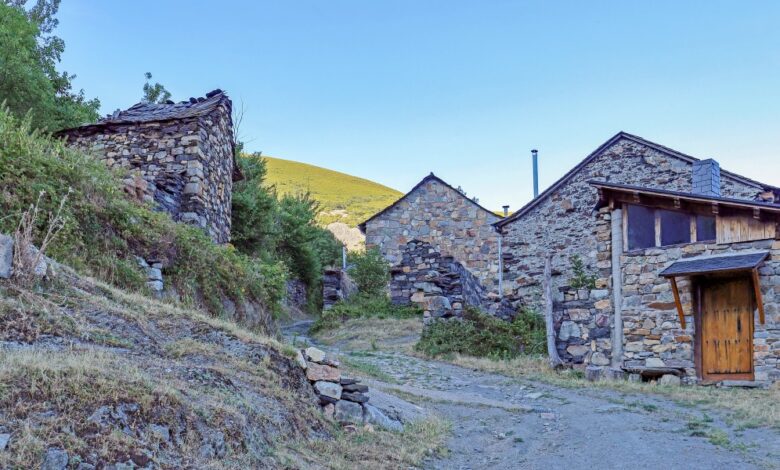
Los Montes de la Ermita, spread across a slope at nearly 1,300 meters above sea level, was always on the edge of survival. Slate houses seem to hang over the valley, while harsh winters and isolation turned daily life into a real challenge. After the last residents left in 1981, the village didn’t vanish: in recent years, enthusiasts have restored the church, school, and several houses, giving the settlement a touch of its former character.
Traces of the past
Quintana de la Peña sits comfortably at the foot of Peña Corada. The main street, paved with stone, climbed upward, surrounded by sturdy houses. Locals farmed and raised sheep, whose wool was valued throughout the region. The San Roque festival brought guests from neighboring villages, but the school closure and gradual outflow of young people took their toll — by the end of the 20th century, the village was deserted.
Becares is a special case. This spot between the Eria and Orbigo rivers was abandoned as early as the 18th century. No traces of houses remain, but you can still find fragments: an old well, crumbling cemetery, and a 17th-century church tower. They serve as reminders of a once-vibrant community, now reduced to shadows of the past.
Memory and return
The abandoned villages of León are more than just ruins. They are living monuments to human resilience, tragedy, and hope. Some have been given a new lease on life thanks to the efforts of descendants and enthusiasts, while others remain silent, yet continue to preserve their stories. Anyone who ventures through these places will find not only stunning scenery, but also food for thought about the changes that shape entire generations.
In case you didn’t know, León is one of the largest provinces in Castilla y León, famed for its harsh climate, rich history, and unique traditions. Dozens of abandoned villages have survived here, drawing researchers, photographers, and visitors from all over Spain. Many of these settlements have become the focus of restoration and cultural initiatives, while others are popular routes for hiking and guided tours.