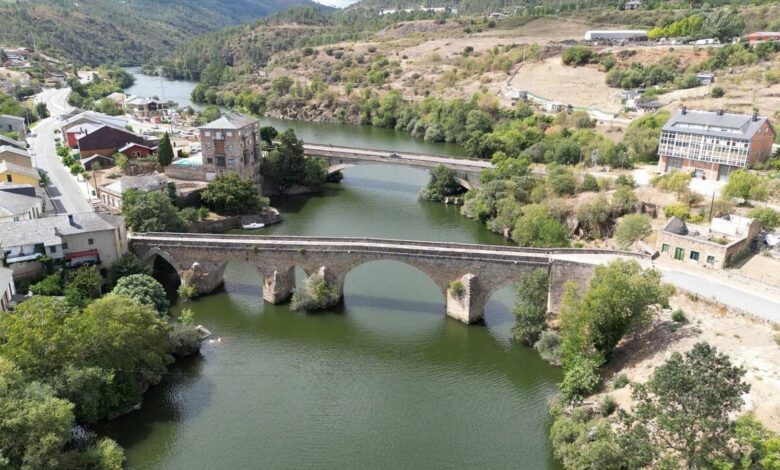
On the banks of the Sil River, where nature and history are woven into one, stands a bridge that defies every traditional architectural canon. Its arches seem to argue with one another: no two are alike, and it is precisely this asymmetry that stops even those who are used to classical forms in their tracks. This centuries-old bridge remains a true enigma for anyone who stands before it.
At first glance, it’s clear: this is more than just an ancient crossing, but a monument that bears traces of different eras. Its irregular outlines prompt questions — why did its builders abandon symmetry, what lies behind this unusual choice? The answers remain elusive, but fascination only grows.
Roman roots
The origins of this bridge stretch deep into the past, when vital Roman Empire roads crossed these lands. The structure links two Galician settlements — Petin and A Rúa — and its story begins back in the days of emperors Titus and Domitian. The famed Vía Nova once ran through here, connecting Bracara and Asturica, and the bridge was a crucial link along this route.
Only certain fragments of Roman masonry have survived to this day — massive stones visible at the base of the fourth pillar and in some rows of the second span. Despite numerous reconstructions, these details recall the bridge’s ancient origins. The rest is the result of centuries of work and ongoing changes.
Arches without rules
The bridge’s current appearance is defined by five arches, each with its own story. Four spans have a pointed shape, while the central one is a classic semicircle that allows water to flow freely even during floods. Its width is nearly twenty meters, which is rare for structures of this type.
The builders chose this location for a reason: a granite outcrop on the left bank naturally narrows the river and provides a solid foundation. This allowed the supports to be placed outside the main riverbed, ensuring the structure’s strength and longevity. This engineering solution explains why the arches are so different—each span was adapted to the unique landscape.
Centuries of trials
The bridge’s history has not been easy. Over its long life, it has been destroyed and rebuilt more than once. In the 16th century, almost the entire structure collapsed, and in 1577 it was restored by master Juan de Naveda. Later, during the 17th century, major repairs were needed again. Other reconstructions are known to have taken place in the 14th, 16th, and 18th centuries.
In the 20th century, the construction of the San Martiño hydroelectric power station had a major impact on the bridge. The water level rose, submerging part of the supports, and concrete appeared in one of the arches—a questionable intervention that disrupted the historical integrity. Today, the bridge is open only to pedestrians: a modern viaduct serves cars, while the old crossing remains for those who appreciate leisurely walks and a sense of history.
A Symbolic Bridge
This bridge is more than just an engineering structure—it’s a true symbol of change and endurance. Its irregularity has become its hallmark, and its history fuels debates and research. Tourists who visit can’t help but pause: every corner, every crack in the stone speaks of a time when Galicia was a crossroads of civilizations.
Locals are proud of this landmark, and travelers return here again and again to feel the breath of history. The bridge itself seems to invite reflection: what matters more—perfect form or the ability to withstand anything?
If you didn’t know, the A Cigarrosa Bridge is one of Galicia’s most unusual monuments, having survived not just changing eras, but numerous reconstructions as well. Its unique architecture and ancient roots make it a must-see for anyone interested in the region’s history and culture. Today, the bridge is open to pedestrians and continues to amaze all who dare to walk its stone slabs.