On May 31, 1906, Madrid was preparing for a grand event—the wedding of King Alfonso XIII and the British princess Victoria Eugenie of Battenberg. The bride, wishing to honor her new homeland, insisted that her wedding gown be crafted by Spanish artisans. No one could have imagined that this dress would go down in history not for its beauty, but because of the tragedy that stained its pure white satin crimson.
This wedding was one of the most anticipated events in Europe’s royal circles. The young Spanish king and the granddaughter of Queen Victoria embodied hopes of renewal for the conservative Bourbon dynasty. Alfonso was known for his openness, passion for sports, and his admiration for England, considered a bastion of liberalism. Yet, this event entered the annals of history for two somber reasons: first, because of a terrorist attack carried out by an anarchist that claimed dozens of lives; and second, because it was the last royal wedding held in Spain for almost ninety years. The next one would not take place until 1995, when Infanta Elena and Jaime de Marichalar were wed in Seville.
The young monarch, only 18 at the time, gave his mother, Queen María Cristina, and Prime Minister Antonio Maura an ultimatum: he would marry for love, and nothing less. The first attempt to arrange his future with British Princess Patricia of Connaught in 1905 failed—her heart already belonged to another. But on that same trip to London, at a dinner hosted by King Edward VII, Alfonso’s eye was caught by a blonde, blue-eyed young woman. It was love at first sight—and, fortunately, the feeling was mutual. The object of his affection was Victoria Eugenie Julia Ena of Battenberg, Queen Victoria’s favorite granddaughter and the goddaughter of Empress Eugenia de Montijo.
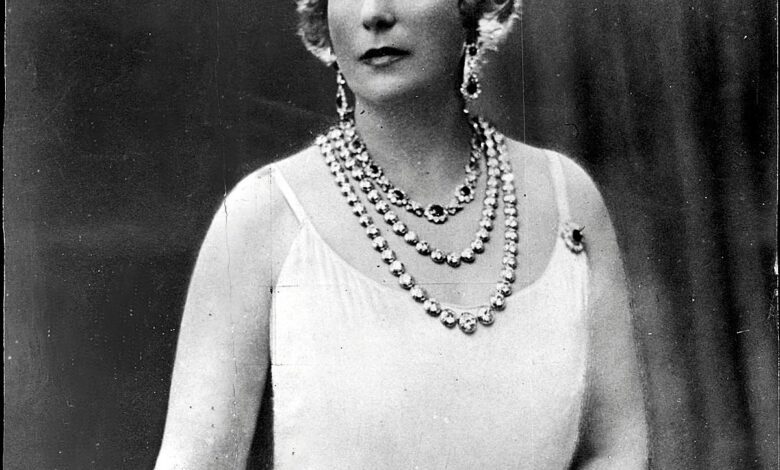
After Victoria Eugenie converted from Anglicanism to Catholicism, preparations for the wedding began. The celebration in Madrid drew guests from around the world, including delegations from China, Japan, and the United States, as well as representatives from nearly every royal house in Europe. The wedding ceremony took place at San Jerónimo el Real. The bride dazzled in her gown, which, while fitting the wedding fashion conventions of the era, was a true work of art.
The creation of the dress was entrusted to Júlia Erce, Madrid’s most sought-after dressmaker, whose atelier on Calle de Alcalá was renowned for its Parisian elegance. The gown, made of white satin with a corset, voluminous skirt, and lavish bodice, was adorned with lace and embroidery. The main decorative motif was the heraldic lily—the symbol of the Bourbon dynasty—accented with silver-thread patterns, lilies, and orange blossoms. A four-meter train added grandeur to the ensemble. Erce managed to combine the Victorian restraint typical of British brides with regal opulence.
Victoria Eugenie’s head was crowned with a veil secured by the magnificent Fleur-de-Lis tiara from the jeweler Ansorena. This ornament, featuring 450 diamonds and 10 pearls set in platinum, was a wedding gift from the groom and later became one of the principal heirlooms of the Spanish crown. Alfonso XIII himself appeared in the full-dress uniform of a captain general of the army. The church was filled with white roses, and a lavish canopy was prepared for the newlyweds.
Thousands took to the streets of Madrid to greet the newlyweds. But the festive mood was shattered. As the wedding procession passed along Calle Mayor, anarchist Mateo Morral threw a bouquet of flowers from a balcony, hiding a bomb inside. The explosion was devastating. The brilliant white satin of the queen’s dress was spattered with the victims’ blood. Twenty-eight people were killed and more than a hundred injured. Despite the shock and horror, it was decided not to cancel the celebration. Victoria Eugenia, barely recovering from the ordeal upon arriving at the Royal Palace, changed clothes, and the banquet went ahead, although the planned ball was called off.
Guests were served consommé, halibut, veal ribs in sherry, and roast capon. The highlight was a 300-kilogram wedding cake—a tradition the bride brought from the United Kingdom, which was a first for Spain. Showing courage and refusing to give in to panic over rumors of another attack, the newlyweds toured Madrid in an open car the following day.
For reference, Alfonso XIII ruled Spain from birth in 1886 (under his mother’s regency until he came of age) until 1931. His reign was marked by political instability and ended with the establishment of the Second Republic, forcing the king into exile. He never formally abdicated the throne. The monarch was an avid sports enthusiast, especially football and automobiles, helping to popularize both in Spain. Alfonso XIII died in exile in Rome in 1941, and his remains were not transferred to the royal pantheon at El Escorial until 1980.