The combination of opulent jewels and tragic fates haunted many of Europe’s royal houses, but the story of the House of Hesse stands out even against this grim backdrop. This noble European dynasty, whose roots stretch back to the 13th century, is tied to the German region of Hesse. Its history is marked by divisions, intrigue, and marriages linking it to the most influential monarchies, including the British and Russian royal families.
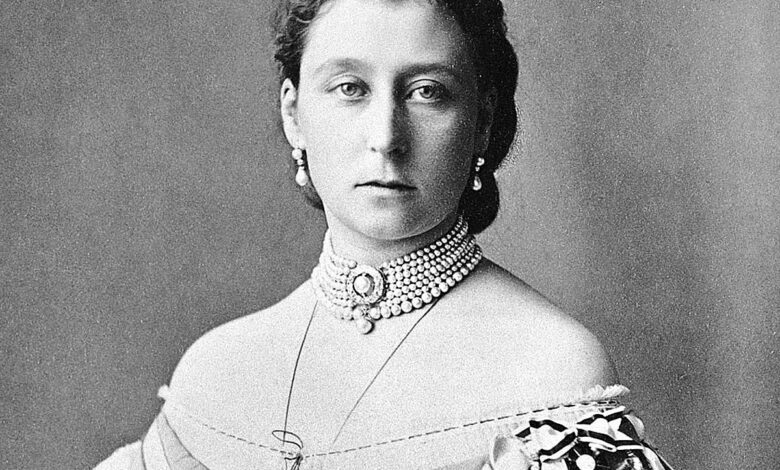
The house reached its peak during the rule of Grand Duke Ludwig IV and his wife, Princess Alice, daughter of Britain’s Queen Victoria. They had seven children whose lives became deeply intertwined with the history of Europe. Among them were the future Russian Grand Duchess Elizaveta Fyodorovna and the last Russian Empress Alexandra Fyodorovna, wife of Nicholas II. However, the family’s happiness was short-lived; a series of misfortunes began with the tragic death of their young son Friedrich, who suffered from hemophilia.
Soon after, in 1878, the family was struck by a typhoid epidemic that claimed the lives of the youngest daughter, Marie, and Grand Duchess Alice herself. These events proved to be only a prelude to even greater tragedies that would befall their descendants.
The Tiara of Bloody Berries
The famed strawberry leaf tiara became both a symbol of the House of Hesse’s grandeur and its curse. This exquisite diamond piece was commissioned in 1861 by Prince Albert, consort to Queen Victoria, as a wedding gift for their daughter Alice, who was marrying Ludwig IV of Hesse. But misfortune struck from the very beginning. Prince Albert died suddenly of typhoid fever before the wedding, and the ceremony took place in deep mourning.
The wedding was called “the saddest in history,” with Queen Victoria attending in a black mourning dress. Princess Alice took the tiara with her to Germany, but her family was soon beset by tragedy: the deaths of two of her children and her own early demise at 35 from diphtheria. Since then, the tiara has been shrouded in ill repute.
A string of misfortunes
After Alice’s death, the tiara passed to her son, Ernst Ludwig. His first wife, Princess Victoria Melita, wore the tiara to the coronation of Nicholas II and Alexandra Feodorovna in 1896. Years later, the entire family of the Russian emperor, including Ernst’s sister Alix, would be brutally murdered by the Bolsheviks. Ernst’s own marriage fell apart, and their only child died of typhoid fever. In his second marriage, the tiara was worn by Princess Eleonore.
The tragedies continued. The heir to the title, Georg Donatus, was married to Princess Cecilia of Greece and Denmark, sister to the future Duke of Edinburgh. In 1937, Cecilia wore the cursed tiara to the coronation of King George VI of Britain. Several months later, a horrific accident occurred. The plane carrying Georg Donatus, a pregnant Cecilia, their two young sons, and his mother Eleonore to London for a wedding crashed over Belgium. There were no survivors. Among the wreckage, the tiara adorned with strawberry leaves was found completely intact in its case.
The Hollywood Heist
But the misfortunes of the treasures did not end there. In April 1945, American troops occupied Kronberg Castle, the residence of the House of Hesse. Before leaving the castle on military orders, the family managed to hide all their jewels. They packed them up, made an inventory, and sealed them inside a zinc box in the basement, bricking up the stash behind a wall.
However, rumors about the hidden hoard reached American officers. Three of them discovered the hiding place and stole the treasures. Among the stolen items were hundreds of carats of diamonds, a unique 116-carat sapphire, tiaras, rings, and bracelets. The perpetrators were eventually court-martialed and convicted, but by then most of the jewels had already been sold in Switzerland and Ireland or sent to the United States. Only about half of the treasures, valued at two million dollars at the time, were recovered. The rest disappeared forever.
For reference, the House of Hessen is a German dynasty that ruled the lands of Hessen from the Middle Ages until the fall of the German Empire in 1918. Over the centuries, it split into several branches, the most prominent being Hessen-Kassel and Hessen-Darmstadt. Through dynastic marriages, members of the House of Hessen became related to nearly all of Europe’s ruling families, including the British Windsors, the Russian Romanovs, and the Spanish Bourbons. Today, the dynasty’s descendants still live in Germany, and the surviving family jewels are preserved in a special House of Hessen Foundation.