Fifty-six years after her death, Queen Victoria Eugenie of Battenberg, wife of Alfonso XIII, has once again become the focus of Spanish society. Her triumphant return took place not to the throne, but to television screens, thanks to the new historical series “ENA” from Televisión Española. The project, based on the novel of the same name by Pilar Eyre, sheds light on little-known chapters of the British-born queen’s life, from her youth to her final days in exile.
Javier Olivares, creator of the acclaimed “Ministry of Time,” presents viewers with the image of a woman ahead of her time—someone who, according to lead actress Kimberley Tell, “would be judged very differently today.” The actress notes that the queen was often criticized for her progressive views and “manly” habits, such as smoking, playing sports, taking an interest in politics, and boldly expressing her own opinions.
The Queen in Exile
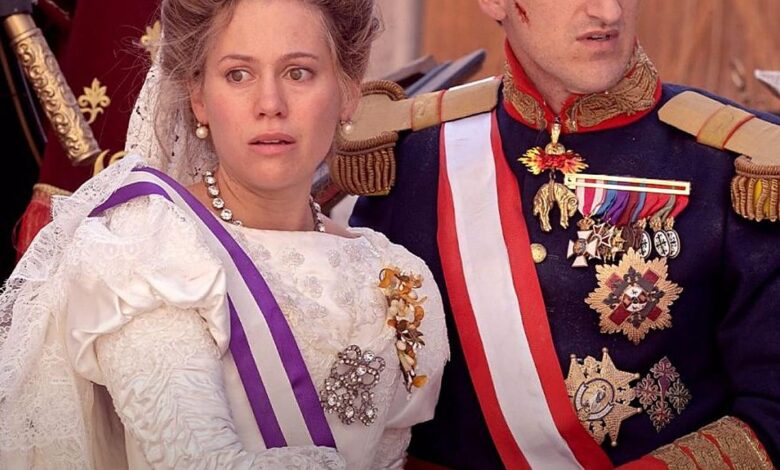
Victoria Eugenie, portrayed in the series by Kimberley Tell, lived an unhappy married life with Alfonso XIII. Their union was marked by tragedy from the very beginning—a terrorist attack on their wedding day. She never felt truly loved by the Spanish people. Pilar Eyre, the author of the novel, explains that, beyond the assassination attempt, the queen endured other hardships, such as the painful conversion to Catholicism, which she never accepted in her heart. In moments of family tragedy, like the death of her son Alfonsito, she saw it as divine punishment for changing her faith.
One of the most beautiful princesses of her time, she arrived from England in 1906 to marry the young King Alfonso XIII, who had been captivated by her during a visit to Buckingham Palace. The mother of six children, she was remembered by her contemporaries as a strong, generous, and sensible woman. However, her modern manners were not well received at the conservative Spanish court. Everything changed with the proclamation of the Second Republic in 1931, when the royal family was forced into exile. Victoria Eugenia ultimately separated from her husband and settled in Lausanne, Switzerland, where she died in 1969.
The unfaithful monarch
Alfonso XIII, portrayed by Joan Amargós, was born on May 17, 1886, at the Royal Palace of Madrid, after the death of his father. Until he came of age, the country was ruled by his mother, Maria Cristina of Habsburg, as regent. His marriage to Victoria Eugenia was marked by mutual reproaches and the king’s constant infidelities. His reign was characterized by economic instability after World War I, military setbacks in Morocco, social unrest, and weak governments.
The military coup by Miguel Primo de Rivera in 1923, approved by the king, was a forceful attempt to resolve the prolonged crisis. However, after the failure to restore constitutional order in 1930, the victory of the republicans and socialists in the 1931 elections led to the exile of the monarch and his family. Alfonso XIII died in Rome in 1941, and in 1980 his remains were transferred to the Pantheon of the Kings at the Escorial Monastery.
Key figures of the era
The series also features other important historical figures. María Cristina of Habsburg (Elvira Mínguez), the second wife of Alfonso XII, was the complete opposite of her cheerful husband. As regent for seventeen years, she relied on the advice of statesman Sagasta and was deeply involved in her son’s upbringing. Beatriz of Saxe-Coburg and Gotha (Lucía Guerrero), a British princess and close friend of Victoria Eugenia, secretly married Infante Alfonso of Orléans, refusing to convert to Catholicism. She became renowned for her humanitarian work during the Civil War.
Her husband, Alfonso of Orléans (Raúl Mérida), the king’s cousin, was a pioneer of Spanish aviation. Because of their morganatic marriage, he was stripped of his titles, but later reinstated. Miguel Primo de Rivera (Mariano Peña) was the military dictator who came to power with the king’s approval to restore order, but ultimately lost support and died in exile. The narrative also includes figures such as the Duchess de la Victoria (María Morales), an aristocrat and head of the Red Cross; the influential politician Count Romanones (Juan Gea); and the famous actress Carmen Moragas (Natalia Ugarte), the king’s mistress, who bore him two children.
Incidentally, Victoria Eugenia was the granddaughter of British Queen Victoria, a carrier of the hemophilia gene. She passed this condition on to her sons, Alfonso and Gonzalo, which caused a deep rift in her marriage. King Alfonso XIII never forgave his wife for ‘tainting’ the royal bloodline. Tragedy haunted their children: their eldest son, Prince of Asturias Alfonso, died of internal bleeding after a minor car accident in the United States.