The Russian language is rich in expressions that may seem simple at first glance but actually contain layers of folk wisdom and customs. One such phrase is “like water off a duck’s back.” Today, it’s associated with indifference, when reproaches and troubles just don’t affect a person. However, few realize that this saying has deep roots, originally connected to protection from illness and misfortune.
If you look at old dictionaries and collections of proverbs, you’ll find that the expression “like water off a duck’s back” wasn’t always used figuratively. In ancient Rus’, there was a special ritual: to protect a child from illness, parents would bathe the child, saying: “Water off the goose, and from our (name)—misfortune.” It was believed that with the water, all bad things would be washed away, leaving the child protected from harm.
Rituals and beliefs
In villages, such rituals were part of daily life. Local healers often used water with a piece of charcoal dropped in it, pouring it over the sick person while uttering special phrases. Variations of these sayings can be found in Vladimir Dal’s collection, “Proverbs of the Russian People”: “All misfortune slides off him like water off a goose,” “Let trouble flow away like water off a goose,” “Shaking off trouble like a goose shakes off water.” In every instance, the goose symbolizes someone from whom all negativity slides off harmlessly.
Such rituals were more than just superstition—they reflected people’s belief in the power of words and ceremonies. For many families, this was a way to protect their loved ones, especially children, from illnesses that could be deadly at the time. Over time, these customs became part of folklore, and the expressions themselves—an integral part of the language.
A shift in meaning
Gradually, the original meaning of the phrase began to change. While it once referred to warding off misfortune, today it’s most often used to describe someone who remains unaffected by anything. For example, when someone shrugs off trouble or ignores criticism, people say: “Nothing sticks to him—like water off a duck’s back.”
This phrase is fairly common in both literature and everyday speech. Aleksandr Solzhenitsyn, in one of his works, wrote: “The camps are like water off a goose’s back for them. Twenty-five years given for their Baptist faith—do they really think that’ll turn them away from their faith?” Here, the expression emphasizes resilience and an ability to withstand hardship.
Why a goose, specifically?
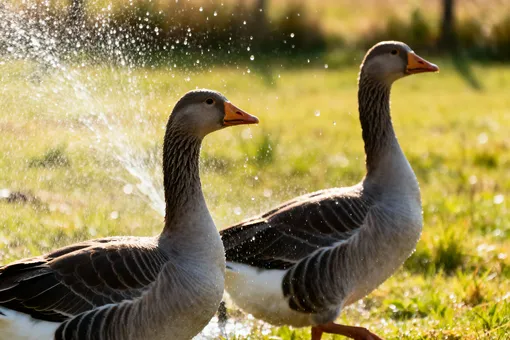
Interestingly, the choice of a goose as a symbol is no coincidence. These birds have a unique trait: their feathers are coated with a special oil secreted by a gland at the base of the tail. Thanks to this, water doesn’t stick to their plumage—instead, it rolls right off without causing harm. Our ancestors noticed this and drew a parallel to people, creating an entire system of rituals and proverbs around it.
In folk culture, geese were often associated with purity, protection, and even magical powers. Their image was used not only in incantations, but also in various festivals and rituals marking transitions from one stage of life to another.
Language and traditions
Today, the expression “like water off a goose’s back” has become part of everyday language. It’s used in all sorts of situations—from casual to formal. However, few remember that behind this phrase lies a whole history imbued with faith in the power of words and customs.
Modern linguists note that such expressions help maintain a link to the past, reminding us how important rituals and traditions were to our ancestors. Even if the phrase has shifted in meaning, its roots go deep into the past, when every word had a special significance.
If you didn’t know, Vladimir Dal (Vladimir Dal) was a renowned Russian lexicographer and author of the famous ‘Explanatory Dictionary of the Living Great Russian Language’ and a collection of proverbs. His works are still considered among the most authoritative sources on the history and culture of the Russian language. Thanks to researchers like him, we can uncover fascinating details about the origins of familiar expressions and understand how they influenced the lives of entire generations.