The jewelry collection of Cayetana Fitz-James Stuart, known as the Duchess of Alba, continues to fascinate even years after her passing. On the centenary of her birth, renewed attention is focused on her unique pieces, most notably the necklace set with imperial emeralds. This jewel was not only a symbol of the family’s status but also the subject of numerous mysteries surrounding its origin and subsequent fate.
The duchess’s collection included not only emeralds but also other precious stones, acquired from Europe’s leading jewelry houses or inherited from her ancestors. Of particular note was the so-called Rusca Tiara (or Ansorena), crafted in 1920 in the kokoshnik style. However, in the 1990s the duchess had to part with this tiara to purchase the horse Gigoló for her son Cayetano Martínez de Irujo, who later competed in the Barcelona Olympics and placed fourth.
Family heirlooms
Among the jewels that remained with the Alba family, the diamond and pearl tiara stands out, worn both by Cayetana Fitz-James Stuart herself and her youngest daughter Eugenia Martinez de Irujo. This tiara is considered part of the legacy of Empress Eugenia de Montijo. According to russpain.com, the duchess’s passion for emeralds was driven not only by their beauty, but also by associations with the Andalusian green color, which held special significance for her. In addition, emeralds have traditionally been believed to bring luck, harmony, and foster spiritual growth.
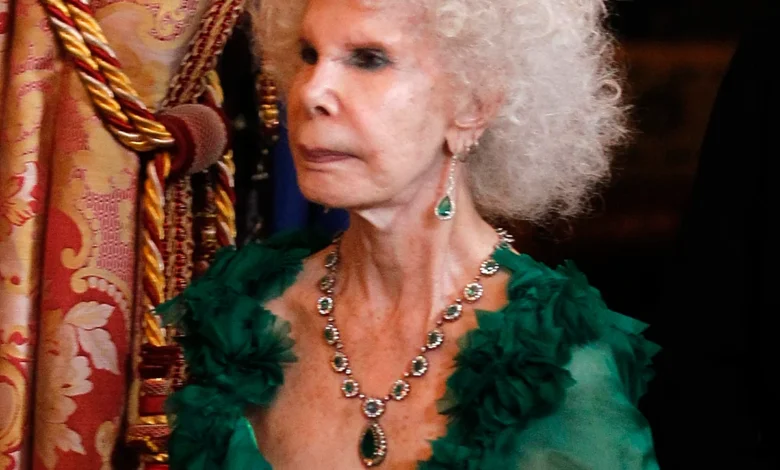
The main mystery remains the necklace with imperial emeralds, crafted in the Art Deco style around 1925. According to one version, it belonged to the Duchess’s aunt, Empress Eugenia de Montijo. The piece is composed of nine large emeralds set in a diamond mounting. The Duchess wore this necklace at major events, such as the ball in honor of Infanta Pilar in Estoril in 1954 and at the reception before the wedding of Prince Juan Carlos I and Sofia in Athens in 1962. In 1989, the necklace was even lent to adorn the statue of Virgen de la Macarena in Seville.
The disappearance of the emeralds
In 1994, the necklace appeared at an auction in Switzerland; however, only its diamond framework was up for sale—the emeralds were missing. This sparked many theories: some believe Cayetana Fitz-James Stuart sold the stones individually to cover the family’s estate expenses, while others suggest the emeralds were removed to create a new jewel. Photos of the Duchess at various events support the second version: in 2011, at a dinner in honor of Prince Charles and Camilla in Madrid, she is seen wearing a different necklace set with emeralds and diamonds, as well as emerald drop earrings, which were also spotted at her daughter Eugenia’s wedding to Fran Rivera in 1998.
Equally fascinating is the story of the emerald tiara, considered one of the most valuable heirlooms of the Alba family. This piece was gifted by Eugenia de Montijo to her sister María Francisca de Sales. The tiara features eight emerald and diamond elements shaped like leaves and is adorned with pearls. In 2024, Sofía Palazuelo wore this tiara again for a portrait photoshoot at the Dueñas and Liria palaces, which became a significant event for enthusiasts of Spanish aristocratic history.
Jewels and cultural heritage
The jewelry collection of Cayetana Fitz-James Stuart not only reflects the tastes and preferences of one of the most renowned aristocrats of the 20th century but also illustrates the complex history of family heirlooms in Spain. Many pieces from the Alba collection have become part of the country’s cultural heritage, and their history continues to spark debates among experts and collectors. Interest in these topics remains strong, as seen in the attention drawn to exhibitions dedicated to royal and aristocratic collections, such as the recent one in London that featured unique items from monarchs’ wardrobes — for more details see the article about the exhibition at Buckingham Palace.
The name Cayetana Fitz-James Stuart has long been synonymous with aristocratic style and eccentricity. She held a record number of titles among European nobility and was known not only for her heritage, but also for her passion for art, collecting, and supporting cultural initiatives. Her jewelry, especially emerald pieces, became iconic of their era and are still discussed by historians and jewelry connoisseurs. Even years after her passing, interest in her legacy remains strong, and the fate of some of her relics is still a mystery.