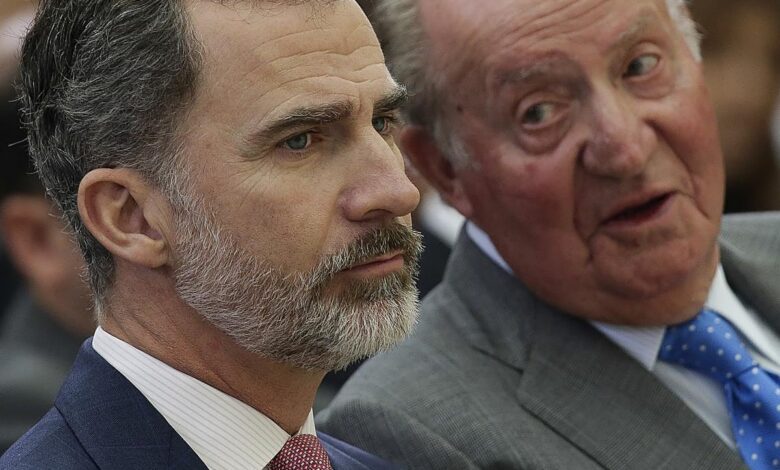
Former Spanish king Juan Carlos, known for his fondness for media attention yet rarely granting interviews, is once again back in the spotlight. The French channel France 3 is preparing to air an exclusive conversation with the monarch, which appears likely to be the last of his life. This news has sparked noticeable concern at Zarzuela Palace, as Juan Carlos’s previous talks with journalists—such as his notorious 1992 interview with Briton Selina Scott—have always generated widespread public reaction. Back then, Spanish media lamented that their own monarch preferred to speak with foreigners. Now, history is repeating itself.
The interview was recorded a few weeks ago in Abu Dhabi, where the honorary king currently resides. While excerpts from his talks with French media have already surfaced in print and caused a stir, the television format promises an entirely different impact. Reading carefully curated quotes is one thing, but seeing the expressions, gestures, and emotions of a man reflecting on an entire life on the throne is another. These are not just words—they are a living testament to an era.
View from Abu Dhabi
Journalist Stéphane Bern, who had the opportunity to speak with the monarch, shared his impressions. He called Juan Carlos I “the hero of his childhood,” a man who restored democracy to Spain after the Franco era. According to Bern, he met a warm, likeable, and easygoing person who, however, has visibly aged physically. Yet his mind remains lively, quick, and full of humor, even when conversing in French—which is no easy feat. The journalist emphasized that nostalgia was the underlying theme throughout their conversation. “He misses Spain, his homeland, his family, and the Spanish people,” Bern noted, adding that this longing could be felt in every word the former king spoke.
This conversation will likely mark the final chapter in Juan Carlos’s public media story. His biographer, French journalist and historian Laurence Debray, confirmed that the monarch does not plan to give any more interviews to the press. If that is the case, the thirty-minute broadcast on France 3 becomes a historical record and his farewell address.
Family resentments and conditions for return
Despite what may sound like a farewell tone, the prospect of upcoming memoirs and related interviews is causing significant tension within the current Royal Household. King Felipe VI’s policy regarding public appearances by family members is extremely strict: absolutely no interviews, ever. Especially if they could include criticism of the family. Yet Juan Carlos has always found ways to express his views to the public, even without speaking directly to journalists.
For example, after a recent luncheon marking the 50th anniversary of the monarchy’s restoration, the former king made his perspective known through his circle of friends. It was, without doubt, disheartening for the royal family to learn of his regrets about rarely seeing his granddaughters, Princess Leonor and Infanta Sofía. Additionally, reports surfaced about his opinion of Queen Letizia, whom he allegedly blames for the lack of family harmony. And, of course, he remains insistent on his desire to return to Spain.
However, his path home is not so simple. The Royal Household has set clear and strict conditions for his return. First, his financial situation must be absolutely transparent. Second, he is required to declare all his assets to the Spanish tax authorities. Third, he must pay taxes in Spain. Until these conditions are met, King Felipe will not agree to his father staying in the country for more than three months—the maximum period allowed for those who are not tax residents.
To recap, Juan Carlos I ascended the throne in 1975 after the death of dictator Francisco Franco and played a pivotal role in Spain’s transition to democracy. For decades, he was one of the world’s most popular monarchs, serving as a symbol of national reconciliation and the country’s modernization. However, in the later years of his reign, his reputation was severely damaged by a series of scandals. These included an expensive elephant-hunting trip in Botswana during the height of the economic crisis, as well as corruption allegations linked to his close relationship with businesswoman Corinna Larsen. These incidents caused a sharp decline in his popularity, ultimately leading to his abdication in 2014 in favor of his son Felipe. In 2020, amid new financial investigations, Juan Carlos left Spain and settled in Abu Dhabi.