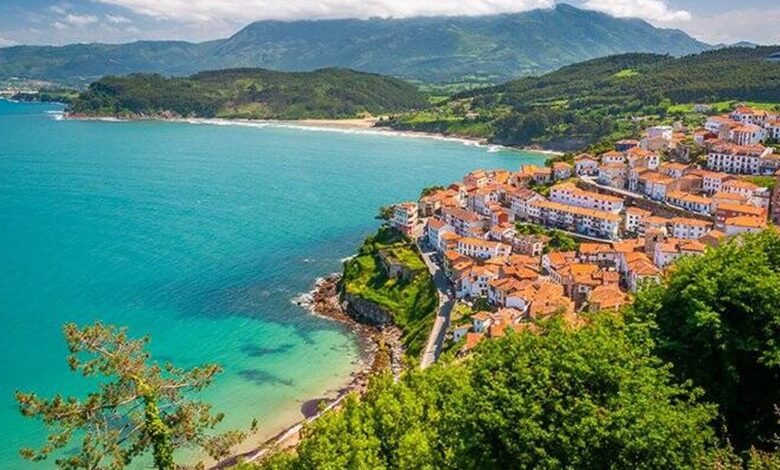
On the Cantabrian Sea coast, in the very heart of the cider region (Comarca de la Sidra), lies Lastres (Lastres)—one of the most picturesque and authentic fishing villages in Asturias. This settlement, part of the Colunga (Colunga) municipality, has managed to preserve its unique character despite growing popularity. In 2010, it was awarded the title of ‘Pueblo Ejemplar de Asturias’ and recognized as a Historic-Artistic Site, underscoring its cultural and architectural significance.
Life in Lastres is inseparably linked to the sea. Its centerpiece is the port, protected from strong waves by a 55-meter breakwater. Every day, a fish auction takes place here, upholding centuries-old traditions and supplying local restaurants with the freshest catch. Walking along its narrow, steep cobblestone streets, you can feel the salty breeze and see how the red-tiled roofs cascade down toward the water. In the past, the coast was defended by the El Castillo (El Castillo) fort, of which only ruins remain today, reminding visitors of the site’s former strategic importance.
The architectural landscape of Lastres is shaped by both modest fishermen’s houses and historic mansions adorned with coats of arms. Among its notable landmarks is the Clock Tower (Torre del Reloj), built in the 18th century. Its mechanism was specially brought from London, and the tower itself served not only to keep time, but also as a bell tower and an observation post overlooking the port. Equally significant is the parish church of Santa María de Sábada (Iglesia de Santa María de Sábada), also constructed in the 18th century. Its monumental bell tower and baroque interior with neoclassical elements make it one of the village’s main symbols.
To fully appreciate the beauty of Lastres, head up to the upper part of the village. The path leads along ancient stairways that have been used by local fishermen for centuries. At the top, you’ll find the San Roque viewpoint (Mirador de San Roque), located next to the chapel of the same name. From here, you are treated to a breathtaking panorama of the village itself, the endless expanse of the Cantabrian Sea, the Sierra del Sueve mountain range (Sierra del Sueve), and, on clear days, even the Picos de Europa. Nearby, there is a rest area equipped with tables, a children’s playground, and barbecue facilities.
In recent years, Lastres has gained wide recognition thanks to the film industry. The village served as a natural set for the popular Spanish TV series “Doctor Mateo.” This has attracted numerous tourists eager to visit the filming locations. A special route has even been developed for them, covering the series’ most iconic sites. In addition, just four kilometers from Lastres lies Playa de la Griega, famous for hosting some of the largest dinosaur footprints ever discovered. The diameter of some sauropod prints reaches 1.3 meters.
A visit to Lastres would be incomplete without exploring the local gastronomy. Numerous cider bars and restaurants, located in the port and the old town, serve dishes made with freshly caught fish and seafood. Here, you can try traditional Asturian cuisine, including the famous fabada or cachopo, while enjoying stunning sea views. Lastres offers a unique combination of natural beauty, rich history, and vibrant culture, making it one of the most memorable destinations in northern Spain.