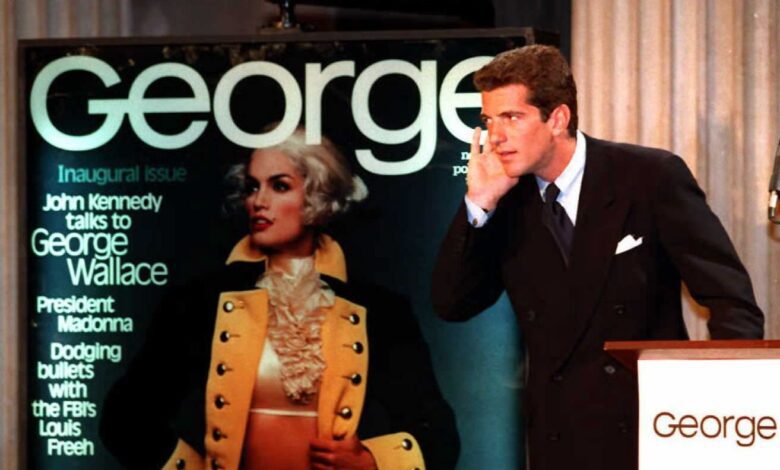
Cindy Crawford’s selection for the debut cover of George magazine in 1995 was not just a media event, but a genuine cultural shift for the United States. The decision made by John F. Kennedy Jr., son of the legendary president, surprised many: instead of a familiar political figure, the cover featured a supermodel reimagined as George Washington. This move sparked heated public debate and came to embody a new perspective at the intersection of politics and popular culture.
At a time when the boundaries between these spheres seemed insurmountable, Kennedy Jr. dared to bring them together in a single project. His vision was to demonstrate how politics and pop culture could influence one another, shaping public opinion. Cindy Crawford, already recognized as an icon of American commercial success, fit perfectly into this concept. Her appearance on the cover in such an unexpected role inspired both admiration and controversy about the appropriateness of such experiments in serious publications.
Behind the selection
For many years, there were rumors that the relationship between Kennedy and Crawford went beyond the professional. However, as it later emerged, Carolyn Bessette, Kennedy’s future wife, played a key role in selecting the model. She insisted that Cindy embodied modern America: an independent, strong, and attractive woman who could represent the era. Other team members supported this perspective, discarding more obvious options—like inviting the sitting president for the cover.
According to russpain, the editorial discussions were tense: everyone suggested their own candidate, but it was Carolyn’s enthusiasm that proved decisive. As a result, the photoshoot with Crawford—captured by renowned photographer Herb Ritts—became one of the most talked-about in American magazine history. The model’s look, featuring a wig and exposed midriff, sparked mixed reactions, but that very aspect secured the cover’s iconic status.
Personal and public
Cindy Crawford’s social media post, thirty years later, reminded the public of how personal this story was for her. For many viewers, the series about the lives of Kennedy and Bessette is just another drama, but for Crawford herself, the events of 1995 became part of her own biography. She shared archival materials, including a handwritten note from Kennedy to the photographer, in which he expressed gratitude for the work and discussed the cover’s design details.
These details offer a fresh perspective on the events of that time. Contrary to rumors, there was no romantic relationship between Kennedy and Crawford—their connection was driven by a shared vision and the ambition to redefine what a modern magazine could be. At the same time, Carolyn Bessette’s involvement underscores how crucial her support was for the project’s success.
Impact on the industry
The first cover of George was not only a breakthrough for the magazine itself, but also set a new tone for the entire industry. After that, many magazines began to feature not just politicians, but also celebrities, models, and entrepreneurs on their covers. This shifted how the media was perceived and broadened the audience for such projects. In Spain, where politics and culture had long existed separately, similar experiments only began to emerge years later.
Today, three decades later, the story of Crawford and Kennedy is seen as an example of how personal choices and bold ideas can shape an entire generation. For Spanish readers, this case is particularly interesting because it shows that even the most unexpected alliances can rewrite the rules in media and culture.
Cindy Crawford is one of the most recognizable models of the 1990s, embodying the American dream and commercial success. Her participation in creating the first cover of George not only cemented her status in the fashion world but also made her a historical figure as the face of an era of change. John F. Kennedy Jr., in turn, is remembered as someone who sought to break stereotypes and bring together different worlds. Their joint project reflected a time when the lines between politics and pop culture began to blur, and new media formats were rapidly gaining momentum.