The significance of the name Extremadura goes far beyond simple geography. For centuries, this region has been not only a battleground but also a place where the destinies of entire peoples have been shaped. Its name holds the key to understanding the complex history of Spanish lands, where every era has left its mark and borders have shifted with the passage of time.
Medieval roots
In the Middle Ages, Extremadura was more than just a territory—it was a true frontline between different worlds. Here, the interests of Christian kingdoms and Muslim rulers collided, and the region’s very name became a symbol of the ongoing struggle for survival and power. The term “Extrema Dorii”—a Latin expression meaning “the edge of the Duero”—indicates that these lands were seen as the outermost fringe of the known world, beyond which lay the unknown.
Although the Duero River does not flow through modern Extremadura, in the Middle Ages it served as a natural border between the north and south of the Iberian Peninsula. It was beyond the Duero that lands in need of protection and settlement began. Over time, the concept of “extremadura” came to be applied to new territories as Christian kingdoms advanced south, reclaiming land from Muslim control.
Soria and shifting borders
The province of Soria plays a special role in this story. During the Reconquista, it was considered the frontline of Castile’s defense and was even referred to as the “head of Extremadura” in official records. As the kingdom expanded, the term gradually shifted southward, encompassing new lands that became the next “extremadura”—the edge where interests and destinies collided.
This shifting of the name reflects not only military strategy but also deeper changes in the perception of space. For people of that era, the frontier was not just a line on the map, but a living organism that was constantly moving, reshaping both the region’s appearance and its meaning. That is why Extremadura came to symbolize change and adaptation, and its name serves as a reminder of the ongoing struggle for a place in the sun.
A diversity of names
Throughout the centuries, the territory of Extremadura was known by different names, each reflecting the character of its time. In Roman days, it was home to Emerita Augusta—modern-day Mérida, the center of the province of Lusitania. The Muslim period brought the name “Al-Tagr al-Adna,” meaning “lower march”—designating the border zone of Al-Andalus.
Castilian chronicles mention the term “Castilian Extremadura,” which covered not only today’s region but also areas such as Soria, Segovia, and Avila. Over time, the region acquired its current name, while among the Roma it is known as Marochandé—“the land of bread,” highlighting its importance for ordinary people.
Land of conquistadors
It is no coincidence that Extremadura became the birthplace of many famous conquistadors of the New World. In the 15th–16th centuries, the region suffered from poverty, inequality, and a lack of prospects. Young people raised amid constant struggle and strict discipline sought a way out of this vicious circle. America became their chance to change their destiny, and the military experience gained on the border proved invaluable in overseas expeditions.
The names of Hernán Cortés, Francisco Pizarro, and Pedro de Valdivia are forever engraved in world history. Their successes were made possible thanks to a unique mix of personal qualities and the character of their homeland. Extremadura instilled resilience, determination, and the ability to act under the most challenging circumstances in its people.
Modern life
Today, Extremadura is a region where past and present are intertwined at every turn. Here, people value tranquility, closeness to nature, and respect for tradition. Expansive dehesas, national parks, and nature reserves create a unique atmosphere that is hard to find elsewhere in Spain.
In recent years, the region has become increasingly attractive for those seeking an alternative to city noise. Affordable housing, rural tourism development, and the introduction of new technologies are opening new opportunities for locals. At the same time, historical memory remains a key part of their identity, and the name Extremadura still reminds people of its unique path.
Extremadura is more than just a geographical concept—it’s living history embodied in its people, traditions, and landscapes. Its name is a challenge, a mystery, and at the same time an invitation to see Spain from a different angle.
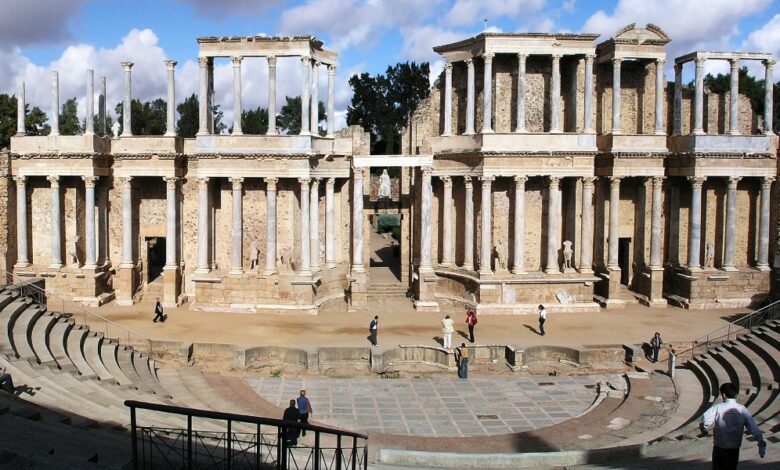
Emerita Augusta, now known as Merida, was founded in 25 BC as a colony for Roman legion veterans. The city quickly became one of the most important centers of Roman Spain, known for its advanced infrastructure, theaters, and aqueducts. Today, Merida is recognized as a UNESCO World Heritage Site and attracts thousands of tourists each year who come to experience ancient history firsthand. The city’s architectural landmarks are a testament to how closely the destinies of people and great civilizations are intertwined in the land of Extremadura.